Introduction
Focused ion beam scanning electron microscopy (FIB-SEM) has become the standard approach for preparing high-quality TEM specimens. For many applications, the workflow is efficient and well established. However, when projects require large numbers of specimens for statistical studies, failure analysis campaigns, manipulation to MEMS devices, or high-throughput research programs, the process can quickly become limited by one critical step: lift-out and specimen manipulation.
Consider a project requiring 20, 30, or even more TEM specimens to obtain statistically meaningful data. Modern FIB-SEM systems can prepare multiple specimens with a high degree of automation and minimal operator intervention. However, every specimen must still be lifted out, transferred, and attached to a TEM grid before analysis. While these manipulation steps are often also automated within the FIB-SEM, they consume valuable instrument time. Every minute spent on lift-out and attachment inside the FIB-SEM is a minute that cannot be used to FIB mill additional specimens. As specimen numbers increase, this competition for instrument time becomes increasingly significant. In a traditional in-situ workflow, the FIB-SEM must perform both specimen preparation and specimen transfer, turning the manipulation step into a throughput bottleneck and limiting the number of specimens that can be produced within a given period.
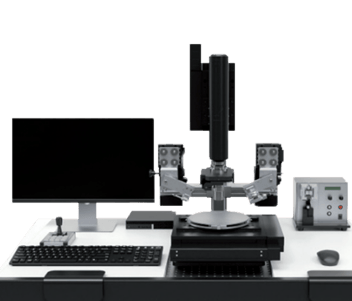
Tescan EXLO addresses this exact challenge. EXLO is a dedicated ex-situ lift-out solution that shifts manipulation and transfer activities outside the FIB-SEM chamber. Instead of tying up the microscope for specimen handling, users can FIB mill the next specimen in the FIB-SEM while simultaneously performing EXLO in parallel outside the FIB SEM. By decoupling these workflows, laboratories can significantly improve utilization of their FIB-SEM investment and increase overall TEM specimen throughput.
For laboratories where speed, volume, and reproducibility are critical, the concept is compelling. But a practical question remains: is ex-situ manipulation fast enough, and can new users learn the workflow quickly enough to deliver real productivity gains in everyday operation?
What We Learned from the EXLO Speed Challenge
To answer the question of whether ex-situ manipulation can be both fast and easy to learn, Tescan sponsored the EXLO Speed Challenge during Microscopy & Microanalysis 2026 in Milwaukee. The competition brought together both experienced EXLO users and participants who had never operated the system before.
The challenge itself was intentionally straightforward. Competitors were asked to manipulate a standardized Praxis™ 3D-printed specimen and manipulate it to a carbon-coated 3 mm TEM grid as quickly as possible.
Two groups competed throughout the week. The Novice Division consisted of users with no previous EXLO experience, while the Veteran Division included experienced EXLO operators. Before competing, all participants received hands-on operation of the remote system to familiarize themselves with the system. Figure 1 and Table 1. summarizes the results.
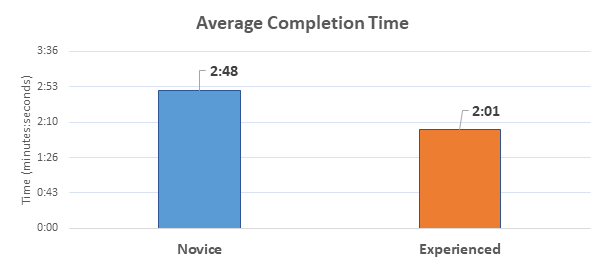
Figure 1. Mean task-completion time by experience level. The graph compares novice and experienced users using average completion time, standard deviation, and minimum and maximum recorded values.
| Group | Mean | Standard deviation | Minimum | Maximum |
| Novice | 2:48 | 1:23 | 0:44 | 4:24 |
| Experienced | 2:01 | 0:47 | 0:58 | 2:51 |
Table 1. EXLO Speed Challenge participant results. The table lists each participant group and the recorded manipulation times in minutes and seconds.
Fast Results From Day One
The outcome of the competition was encouraging for anyone considering EXLO as a high-throughput specimen preparation tool. As expected, experienced users completed the task faster on average, recording a mean manipulation time of 2:01 minutes compared with 2:48 minutes for novice users. However, the difference between the two groups was surprisingly small.
What stands out is not that experienced users were faster, but rather how quickly first-time users were able to approach the performance of experienced operators. Following only a brief introduction to the workflow, novice participants were routinely completing specimen transfer in less than three minutes.
Several individual performances reinforced this observation. The fastest novice competitor completed the entire workflow in 44 seconds, outperforming the fastest result recorded in the experienced division at 58 seconds. While a single result does not define overall performance, it demonstrates that the workflow itself is easy to learn and intuitive for new users to achieve exceptional results almost immediately.
The variability of the results also tells an interesting story. Although the novice group showed a broader spread of completion times, the overall distribution remained remarkably tight considering that many participants were using EXLO for the first time. This suggests that operators can become productive very quickly without requiring extensive practice or highly specialized manipulation skills.
Want to see the workflow in action? Explore how ex-situ lift-out helps increase TEM specimen throughput while freeing valuable FIB-SEM time.
Key Takeaway
The EXLO Speed Challenge demonstrated two important characteristics of the EXLO workflow. First, specimen manipulation can be performed extremely quickly, with both novice and experienced users routinely completing the transfer process in only a few minutes. Second, performance is not heavily dependent on years of operator experience. New users were able to achieve results remarkably close to experienced practitioners after only brief exposure to the system.
For laboratories looking to increase TEM specimen throughput, this combination of speed and accessibility may be just as important as the throughput gains themselves. EXLO not only frees valuable FIB-SEM time for specimen preparation, but also makes advanced lift-out workflows more approachable for a wider range of users.
Written by Lucille GIannuzzi
Regional FIB-SEM Specialist, Tescan


Related Resources
Tescan EXLO™
Fast, reliable ex-situ TEM specimen transfer.

Faster TEM Sample Preparation
See how EXLO improves TEM workflow efficiency.

TEM AutoPrep™ Pro
Automated TEM lamella preparation with FIB-SEM.