Own the Dynamic Quality standard
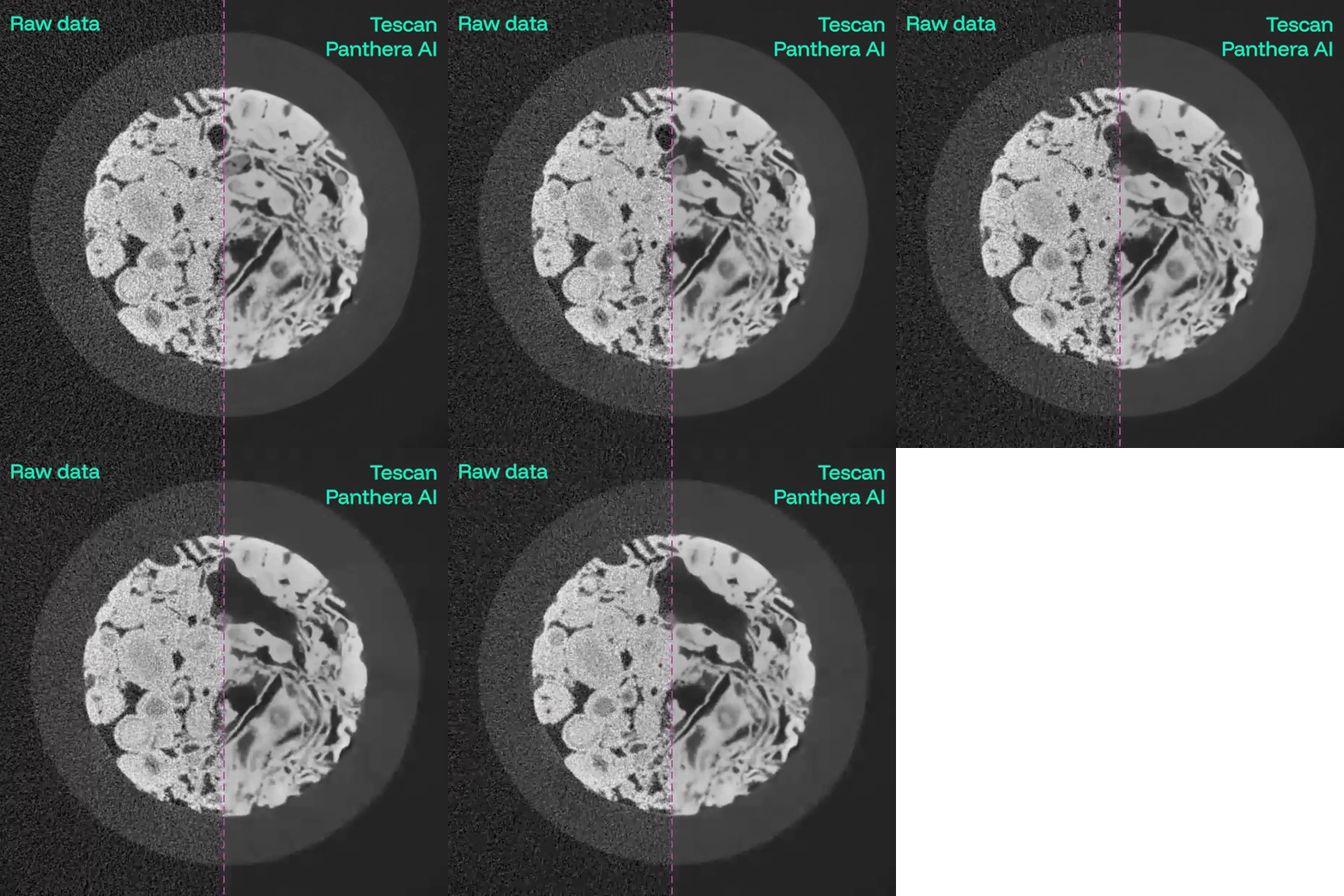
Panthera™ AI applies AI denoising to both 3D and 4D micro-CT datasets, reducing the noise penalty that typically accompanies fast or low-dose acquisitions. Whether operating on a single 3D volume or a full 3D + time dataset, Panthera™ AI selectively suppresses noise while preserving structural information, improving the signal-to-noise ratio (SNR) to support interpretation and quantification.
In dynamic (4D) experiments, Panthera™ AI can additionally leverage the time dimension to better differentiate true signals from random noise, keeping high-frame-rate scans clear enough for interpretation and quantification. In static (3D) imaging, this capability allows for shorter scans, lower doses, or higher throughput without sacrificing data quality. This means you can move from acquisition to decisions faster, without spending your time rescuing noisy datasets.
Panthera™ is available as an optional module in eligible configurations and upgrade packages, supporting both high-speed dynamic workflows and high-quality 3D micro-CT acquisitions.
Panthera™ AI is designed for researchers working with demanding datasets, whether capturing time-dependent phenomena where there is only one chance to observe the event, or accelerating conventional 3D scans where time, dose, or throughput is critical. In both cases, higher speed typically introduces noise that limits interpretability, weakens measurement confidence, and slows downstream analysis. Panthera™ AI directly addresses this trade-off by filtering noise at the data level, keeping fast acquisitions trustworthy.
This marks the shift from fast images to usable evidence. With Panthera™ AI, you can scan faster without the resulting data becoming noisy or unreliable. The result is speed that still supports visual interpretation, quantitative analysis, and reporting.
In doing so, Panthera™ AI strengthens continuity across the Dynamic-to-Detail workflow. By delivering cleaner dynamic datasets, it supports volume-of-interest-guided detector switching in multiple-detector architectures. This lets you capture a noise-reduced movie of the event and transition seamlessly to high-resolution inspection of the root cause, without removing the sample or breaking the in-situ chain.

.png?width=201&height=200&name=_%20Application%20area%20icon%20(3).png)


.png?hsLang=en)