Compox™ 

Python-based extensibility layer for Tescan 3D Viewer™ and Tescan Picannto™ 

Compox - hero - desktop
Compox - hero - mobile

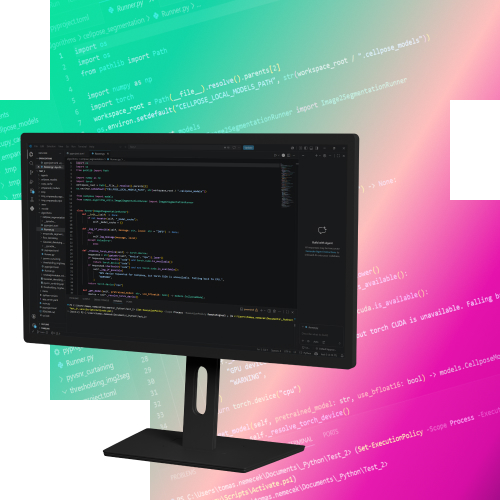
Compox™ is the Python-based extensibility layer for Tescan 3D Viewer™ and Tescan Picannto™. It enables advanced users to connect custom algorithms, AI models, and specialized data-processing workflows directly to the application environment.

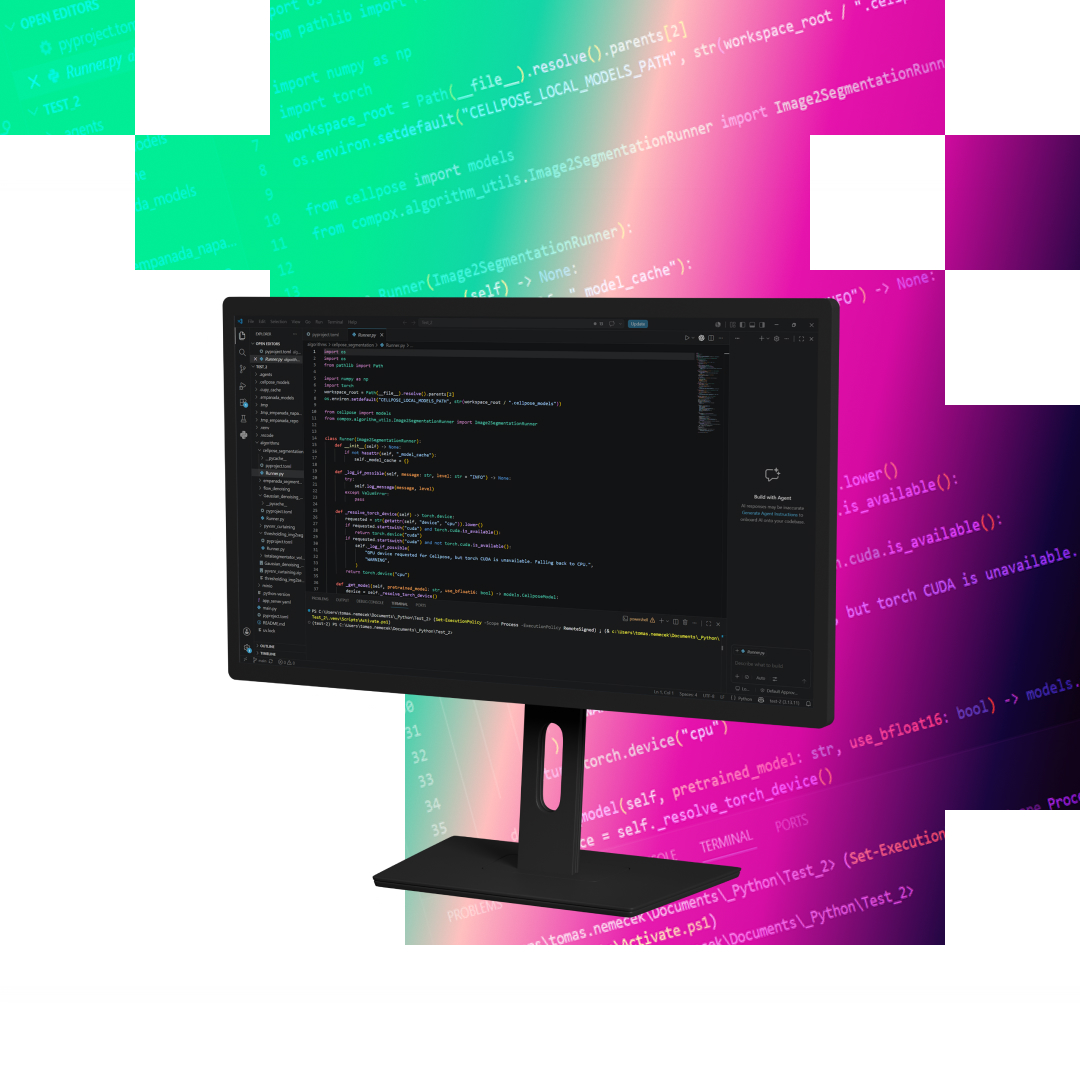
Instead of acting as an embedded Python interpreter, Compox™ serves as a bridge between external Python development environment and Tescan 3D software. Algorithms can be developed in the user’s own Python environment, packaged for deployment, and called from inside the application with defined inputs, outputs, and controllable parameters.

This allows custom methods to be applied to datasets already loaded in Tescan 3D Viewer™ or Tescan Picannto™, helping users extend segmentation, denoising, artifact reduction, measurement, or other domain-specific analysis workflows without rebuilding their entire toolchain.

Compox supports a more maintainable approach to custom development: algorithms can be reused, updated, versioned, and deployed across supported workflows. This helps research and industrial teams keep pace with evolving AI methods, scientific repositories, proprietary algorithms, and customer-specific processing requirements. 

The Compox™ code is publicly available on GitHub, helping lower the barrier of entry for advanced users and development teams who want to build, adapt, and deploy custom tools for Tescan 3D Viewer™ and Tescan Picannto™. See the repository on GitHub.

Typical applications

  • Custom AI Segmentation Workflows 
    Integrate proprietary AI models or specialized segmentation methods into supported Tescan 3D software workflows, for example to segment specific materials, phases, tissues, or structures. 


  • 3D Data Processing 
    Create and deploy custom algorithms for application-specific artifact reduction, noise suppression, image enhancement, or preprocessing tasks.

  • Customer-Specific Analysis Tools 
    Bring methods from scientific repositories or in-house development into Tescan 3D software workflows, and apply custom analysis tools directly to loaded datasets.

WHERE Compox™

makes the difference

Develop methods in your preferred Python environment

Compox™ is not an embedded Python interpreter inside the application. Custom methods are developed in the user’s own Python environment, where advanced users can work with their preferred libraries, tools, and development workflows. Compox™ then connects these methods to supported Tescan 3D software, making them available from the application interface. 

Run custom methods on loaded 3D data

Once connected through Compox™, custom algorithms can be applied to datasets already loaded in Tescan 3D Viewer™ or Tescan Picannto™. This allows advanced users to extend existing visualization, segmentation, enhancement, or analysis workflows without exporting data to a separate toolchain.

Package, update, and reuse algorithms

Compox™ provides a structured way to package algorithms with their configuration, parameters, and required assets. This makes custom methods easier to update, reuse, and maintain across supported workflows as data, methods, and application requirements evolve. 

Bring research methods into application workflows faster

Many advanced image-processing and AI methods first appear in scientific repositories, internal research code, or customer-specific workflows. Compox™ helps connect these methods to Tescan 3D software, making it easier to evaluate, adapt, and use new processing approaches in a controlled application environment.

Tescan Spectral CT Applications

_ Application area icon (3)
Tescan Spectral CT in Electronics and Semiconductors

Non-destructive spectral imaging for material verification and internal inspection of advanced electronic assemblies.

TrueContrast™ multi-energy imaging for differentiating polymers, metals, and encapsulants

  • K-edge detection for accurate identification of high-Z elements

  • Non-destructive visualization of interfaces and buried defects in electronic packages

  • Spectrum comparison tools for verifying material uniformity and contamination sources

Tescan Spectral CT delivers compositional insight where conventional micro-CT cannot. Engineers can distinguish packaging materials, solder alloys, and internal structures without sectioning or coating—supporting reliable failure analysis, design validation, and quality assurance across next-generation electronic devices.

_ Application area icon
Tescan Spectral CT in Materials Science

Multi-energy micro-CT for elemental and structural differentiation in complex, multi-phase materials.

  • Elemental mapping for identifying fillers, dopants, or additives in polymer composites

  • Spectral contrast for distinguishing polymers, ceramics, and metals with similar densities

  • Non-destructive 3D analysis of internal interfaces and phase boundaries

  • Integrated Spectral Suite for correlating elemental and structural data in one workflow

In materials research, Spectral CT enables scientists to explore the relationship between structure and composition without destroying samples. Researchers can visualize distribution of additives, analyze composite uniformity, and study degradation pathways—supporting more reliable material design and performance assessment.

Application area=GS
Tescan Spectral CT in Geoscience and Mining

Full-spectrum micro-CT for 3D elemental and structural insight into geological samples.

  • Non-destructive 3D elemental mapping of rocks, ores, and mineral inclusions

  • K-edge detection for locating and identifying high-value or trace elements like gold or rare earth elements

  • Enhanced contrast for complex mineral assemblages and pore networks

  • Large-volume spectral scanning for full-core or fragment-scale analysis

For geoscientists and mining professionals, Spectral CT provides simultaneous elemental and structural data from intact samples. It supports mineral identification, ore classification, and recovery assessment—reducing dependency on destructive assays while preserving geological material for further study.

TESCAN SPECTRAL SUITE

INTEGRATION THAT DRIVES INSIGHT

Tescan Spectral CT works seamlessly with SPECTRAL Suite and Acquila™ micro-CT control software to streamline spectral imaging from acquisition to analysis. Used as an add-on with the UniTOM XL platform, users can target volumes of interest, capture full-spectrum data, and visualize structural and elemental information in one workflow.

Researchers benefit from intuitive controls, guided reconstruction, and automated spectral processing. Spectral Suite handles spectrum matching, K-edge detection, and compositional mapping with minimal setup. This delivers consistent, reproducible results across samples and accelerates multi-energy micro-CT analysis.

Unlocked content

Unlock
Tescan insight

leave a contact to access

Get the most out of Tescan

This is more than information; it's an advantage. We've compiled our technical whitepapers, detailed product flyers, and on-demand webinars to provide you with the knowledge that makes a real difference. Sign up now to access the insights you need to make an impact.

Panthera AI

Technical specification

What it is

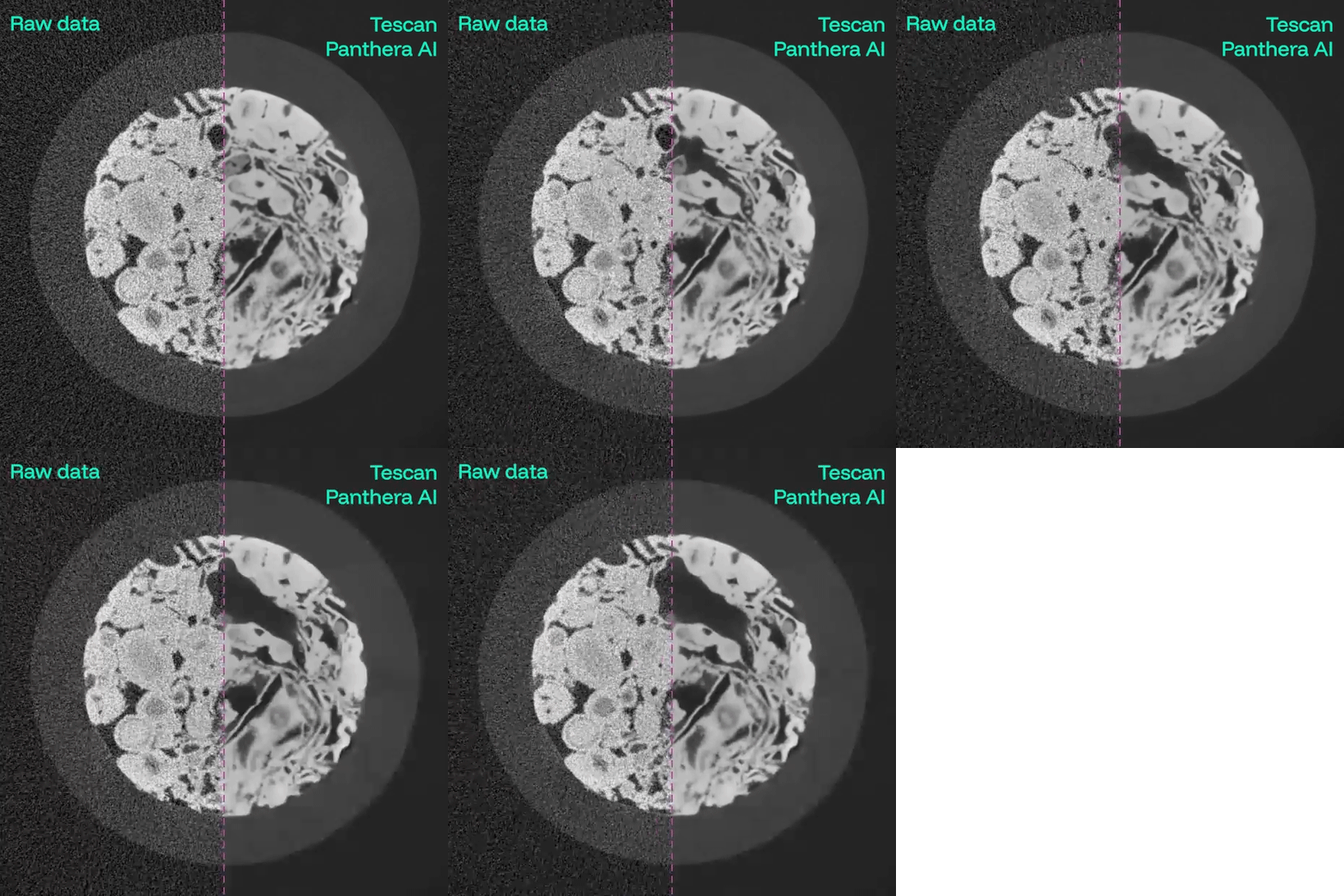
AI-based noise removal module for 3D and 4D micro-CT datasets, including AI 4D denoising for 4D (3D + time) data. 

It comes pre-trained and, where appropriate, can be further tailored using application-specific datasets to better match your imaging conditions.

What it improves

Reduces the noise penalty in fast (dynamic) scans and significantly improves SNR, supporting clearer dynamic monitoring or higher sample throughput without compromising image quality.

Where it fits

Across the micro-CT workflow, from fast monitoring through reconstruction review, VOIS-guided navigation, and follow-up detail, supporting Dynamic-to-Detail continuity.

How to evaluate

Talk to a Tescan application specialist about your dynamic micro-CT workflow
See Panthera™ AI on your Tescan micro-CT datasets. Panthera AI is integrated into the Tescan workflow and is not a standalone solution

What it is

AI-based noise removal module for 3D and 4D micro-CT datasets, including AI 4D denoising for 4D (3D + time) data. 

It comes pre-trained and, where appropriate, can be further tailored using application-specific datasets to better match your imaging conditions.

What it improves

Reduces the noise penalty in fast (dynamic) scans and significantly improves SNR, supporting clearer dynamic monitoring or higher sample throughput without compromising image quality.

Where it fits

Across the micro-CT workflow, from fast monitoring through reconstruction review, VOIS-guided navigation, and follow-up detail, supporting Dynamic-to-Detail continuity.

How to evaluate

Talk to a Tescan application specialist about your dynamic micro-CT workflow
See Panthera™ AI on your Tescan micro-CT datasets. Panthera AI is integrated into the Tescan workflow and is not a standalone solution

limestone-dynamic-opt2

GET IN Touch

Contact us

map

Where you can find us:

Tescan Brno
Libušina třída 21
623 00 Brno
Czech Republic


info@Tescan.com 

130405923 us US 37.09024 -95.712891 25.3575 29.349345 20.67957527 42.082797 39.91384763 -33.693421 13.93320106 3.039986586 31.997988 38.050985 47.579533 48.1485965 58.375799 54.663142 19.195447 56.975106 47.916997 50.493053 45.868592 10.79556993 44.35660598 43.2371604 55.536415 14.557577179752773 32.100937 -6.116829 -6.212299277967318 33.600194 -12.08688 23.7104 -33.471062 31.998740087 -23.69149395 43.462349 51.529848 49.1893523 49.197486 25.072375 31.075811 1.299027 40.676979 52.30150662 51.013813 35.684121 37.566531 52.246622 40.581349 39.911632 -26.1811371 41.818215 33.429928

No distributors found.