
Fine-tune and create new materials surface characteristics by unprecedented milling precision and Isotope Selection seamlessly using the Wien filter in our ion implantation tool.
Precise Multi-Ion Implantation for Discovering the Full Spectrum of New Materials Possibilities
Tescan QuiiN™
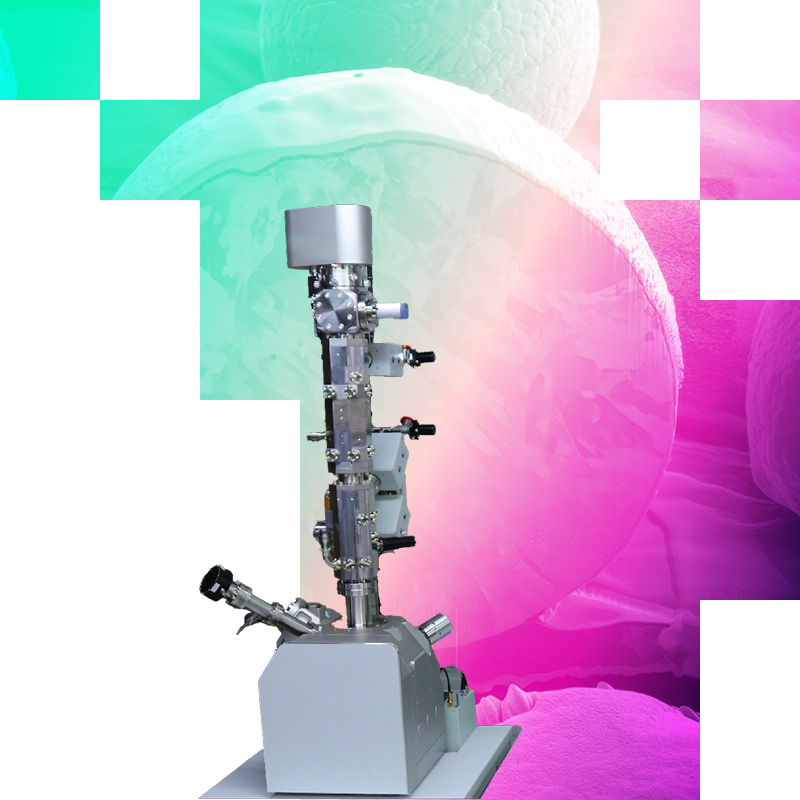
Tescan QuiiN™ (Quantum Ion Implanter at Nanoscale) is a versatile ion beam system designed for implantation applications. With its ability to precisely place ions into material structures, QuiiN™ is an ideal platform for advanced research in quantum computing and semiconductor technologies.
- Precise region localization and controlled dose implantation of selected ions and gases through electrostatic SEM and advanced FIB.
- In-situ annealing to >950 °C with FurnaSEM 1000 heating stage.
- Tailored implantation experiments, analytical routines, and point-based milling strategies with Pegasus GUI.

Tescan AMBER X2 in Materials Science
Gain the detail you need to understand how materials behave, from nanoscale structures to millimeter-scale volumes.
- Comprehensive 3D characterization for microstructural studies
- Automated TEM lamella preparation with TEM AutoPrep Pro™
- Correlative multimodal analysis combining EDS, EBSD and ToF-SIMS
- Large-volume milling for full-field reconstruction and structural insight
AMBER X2 gives materials scientists a reliable way to study metals, ceramics, polymers and composites with both precision and scale. Its Xe plasma FIB and field-free SEM architecture support high-resolution imaging without unnecessary beam damage. This helpa you explore structure–property relationships and track material changes under load, heat or environmental exposure.

Tescan AMBER X2 in Energy and Batteries
Get a clearer view of electrode architecture, interface behavior, and the mechanisms that drive degradation.
- Damage-free plasma FIB-SEM workflows for electrodes and interfaces
- Cross-sectioning and 3D reconstruction of electrodes and solid-state architectures
- Correlative EDS and ToF-SIMS for chemical and structural gradients
- Safe, contamination-free milling of lithium-containing and beam-sensitive materials
AMBER X2 helps battery researchers examine internal structures with clarity, from active material morphology to subtle interface changes. Its high-throughput plasma FIB and multimodal analysis tools reveal degradation pathways, lithium distribution patterns, and stability issues. This gives you the insight needed to refine materials and design more reliable energy-storage systems.
.png?width=201&height=200&name=_%20Application%20area%20icon%20(3).png)
Tescan AMBER X2 in Semiconductors
Uncover the electrical and structural details of today’s most advanced devices
Uncover the electrical and structural details of today’s most advanced devices with Tescan AMBER X 2 Plasma FIB-SEM. Purpose-built for semiconductor applications, AMBER X 2 combines Xe plasma FIB with proprietary Nanoflat, Chase, and C-Maze chemistries to deliver uniform, artifact-free delayering at sub-10 nm nodes.
The system ensures you have reproducible workflows across logic, memory, and I/O regions, supporting electrical fault isolation, failure analysis, and transistor-level probing.
- Perform artifact-free delayering with Nanoflat, Chase, and C-Maze chemistries
- Protect device integrity using low-kV Xe Plasma FIB milling
- Control every step with end-point detection and live monitoring
- Integrate delayering with in situ nanoprobing in a single workflow
- Deprocess I/O and thick metal layers using low angle polishing
Resolve critical details with BrightBeam™ UHR SEM imaging at sub-500 eV
.png?width=200&height=200&name=_%20Application%20area%20icon%20(1).png)
Tescan AMBER X2 in Life Sciences
Work confidently across cryogenic and room-temperature workflows, whether you're studying ultrastructure or preparing samples for high-resolution imaging.
- Large-volume 3D FIB-SEM tomography of hard biological materials, including bone, shell and dental tissue
- High-quality cryo lamella preparation with MISTRAL™ Plasma FIB for fast rough milling and precise low-energy polishing
- Integrated CLEM workflows with METEOR 2.0 for accurate ROI targeting
- Built-in cryo nanomanipulator for temperature-controlled, reliable lift-out
- Advanced analytical options including EDS, ToF-SIMS and EBSD
AMBER X2 brings plasma FIB speed to demanding life science studies, from large-volume 3D analysis to delicate cryo sample preparation. Its stable beam performance helps you obtain clean, artifact-free results across biological interfaces, mineralized tissues and complex structural hierarchies.
Technical specification
with specialist