WEBINAR | Up to 40% Faster Automated TEM Lamella Preparation with new Ga⁺ FIB Column

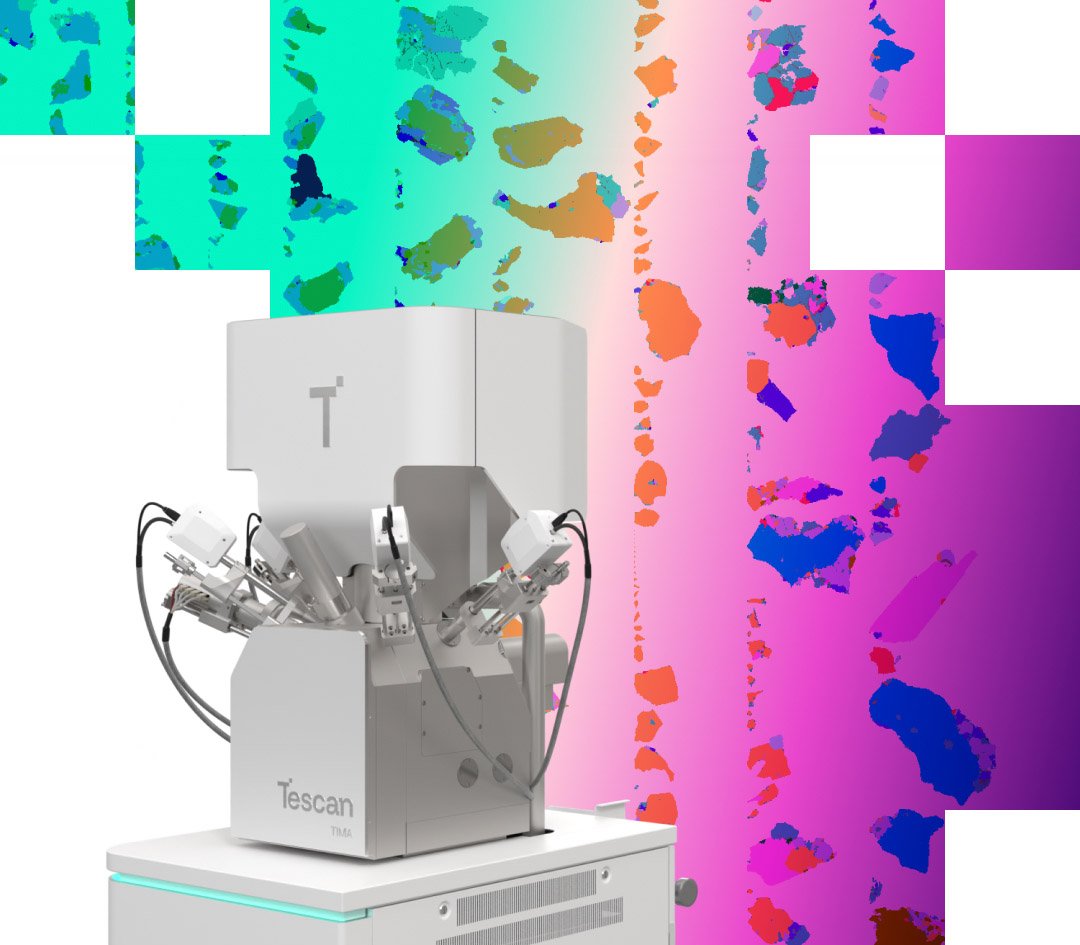
Tescan TIMA 

Tescan TIMA
TIMA

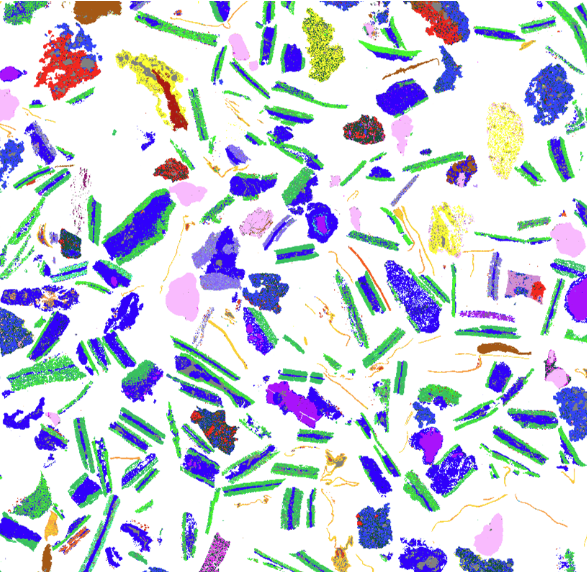
Enhance mineralogical SEM analysis with Tescan TIMA, a system for routine characterization in exploration, geometallurgy, and mineral processing. Multi-EDS acquisition, stable imaging, and automated beam control deliver consistent quantitative data on mineral liberation, associations, and elemental distribution across diverse sample sets.

  • Achieve unattended, automated mineralogical acquisition with TIMA Online

  • Characterize particle populations using adaptive analytical modes and multiple EDS detectors

  • Quantify mineral liberation, associations, and locking for process optimization

  • Evaluate elemental and mineralogical variability across size fractions and streams

  • Classify minerals accurately using robust mineral libraries and real-time spectral control

  • Streamline review and reporting with TIMA Offline and customizable workflows

HOW TESCAN TIMA

ENHANCES SEM WORKFLOWS FOR MINERALOGY AND PROCESS ANALYSIS

Effortless Data Collection Through Automation

TIMA Online automates mineralogical acquisition, calibration, beam setup, and particle detection. This minimizes manual intervention and ensures that large batches of epoxy blocks or thin sections can be analyzed with consistent parameters.

High Throughput for Large Sample Sets

Advanced scanning modes, multi-EDS configurations, and spectral summing support rapid assessment of particle sizes, mineral phases, and distributions. This is suited for plant monitoring, variability studies, and high-volume testwork campaigns.

Accurate Mineral Identification Using Robust Spectral Data

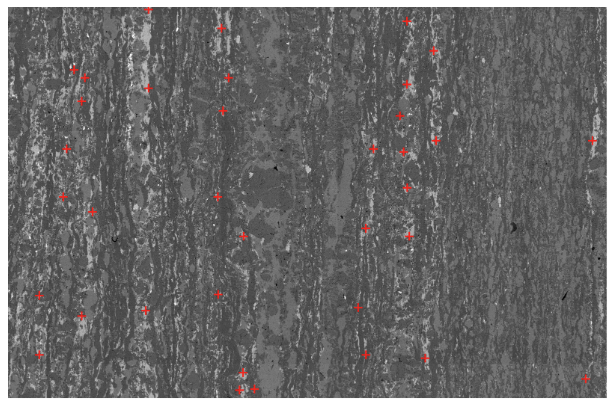
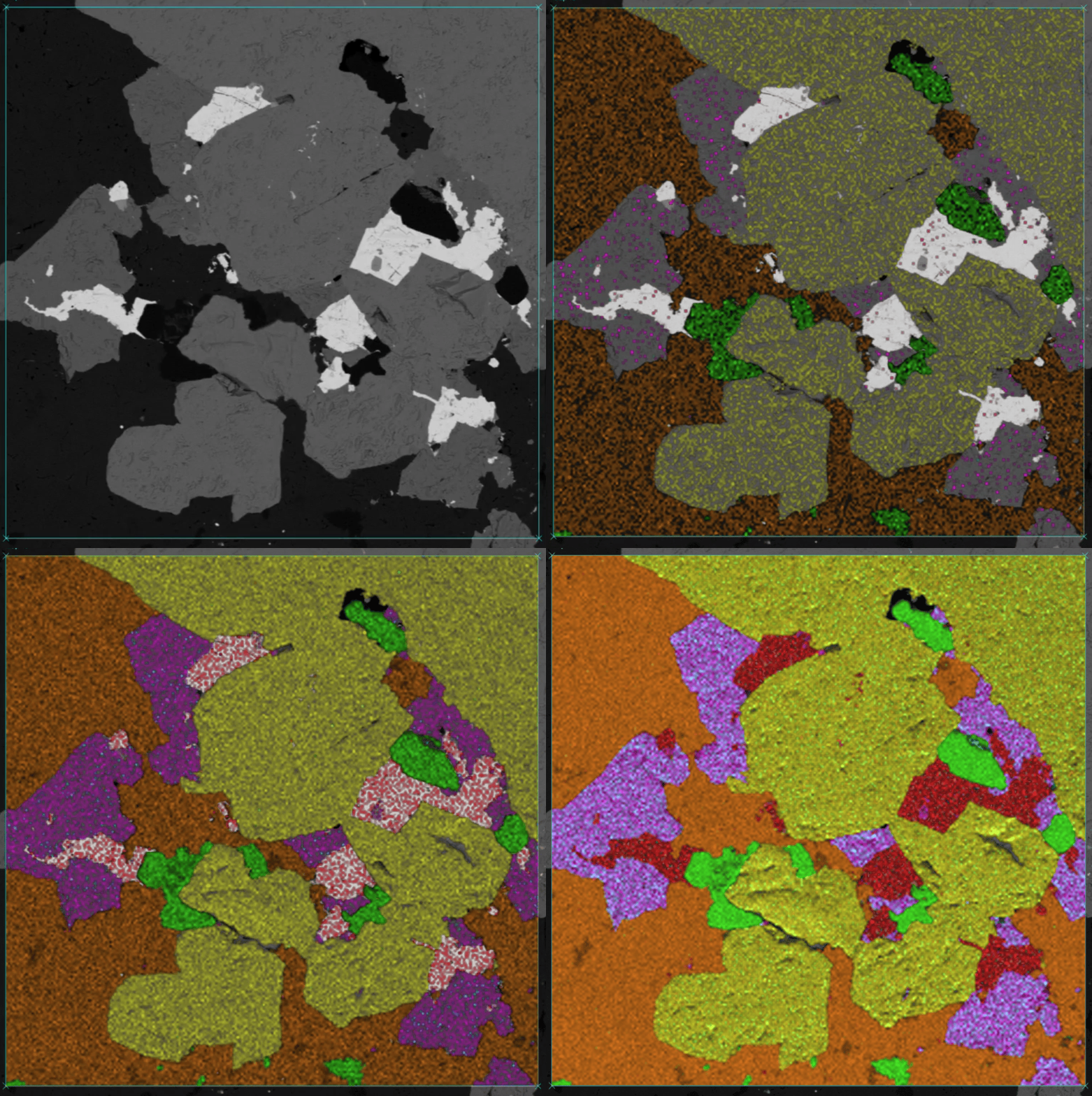
Real-time EDS evaluation and extensive mineral library support enable confident recognition of trace and light-element-bearing phases. Adaptive analysis tools tailor acquisition to each mineral, improving classification accuracy.

Flexible Analysis Across Complex Textures

TIMA’s particle and grain categorization tools quantify complex textural features, including rims, inclusions, veinlets, and disseminated mineral grains. These workflows support decision-making in grinding, separation, and concentration processes.

Consistent Reporting and Quality Assurance

Built-in QA/QC tools, automated calibration, and template-based workflows help maintain reproducibility across campaigns. This consistency is vital for reconciliation, metallurgical balancing, and comparative dataset evaluation.

Extensive Sample Capacity for Operational Efficiency

The optional extended chamber accommodates high-capacity holder, enabling users to process over 40 epoxy blocks in a single run. This supports continuous operation and reduces per-sample analysis time.


TESCAN TIMA APPLICATIONS

Understanding Mineral Liberation for Recovery Improvement

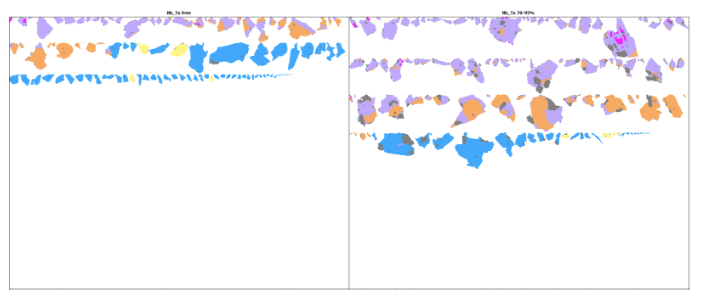
Quantify liberation classes for process optimization

  • Assess liberation of target minerals
  • Distinguish free, locked, and middling particles
  • Evaluate mineral exposure and contact types
  • Support decisions in grinding and separation

TIMA quantifies the liberation degree of valuable minerals, helping operators balance recovery and concentrate quality. These data guide comminution adjustments and separation strategies, reducing mineral losses while improving processing efficiency.

Determining Mineralogical Composition in Complex Ores

High-resolution modal analysis for compositional variability

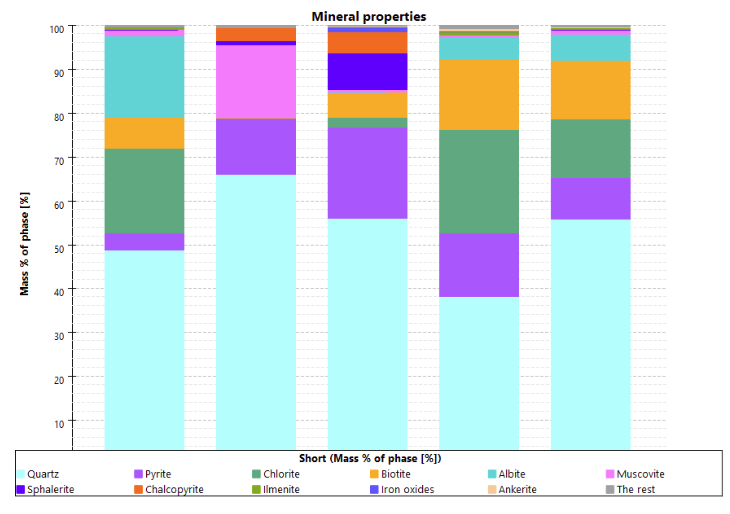
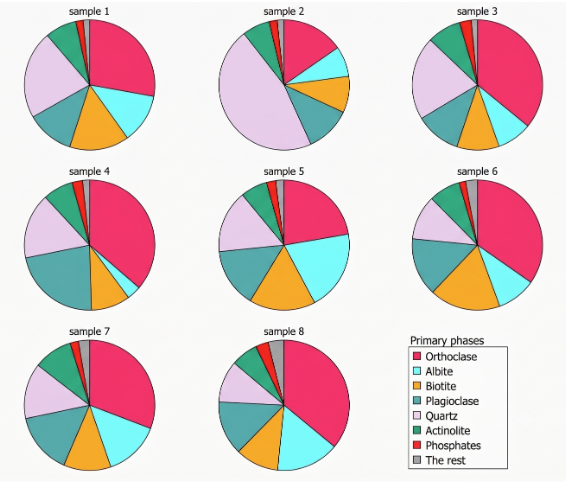
  • Quantify modal mineralogy across samples
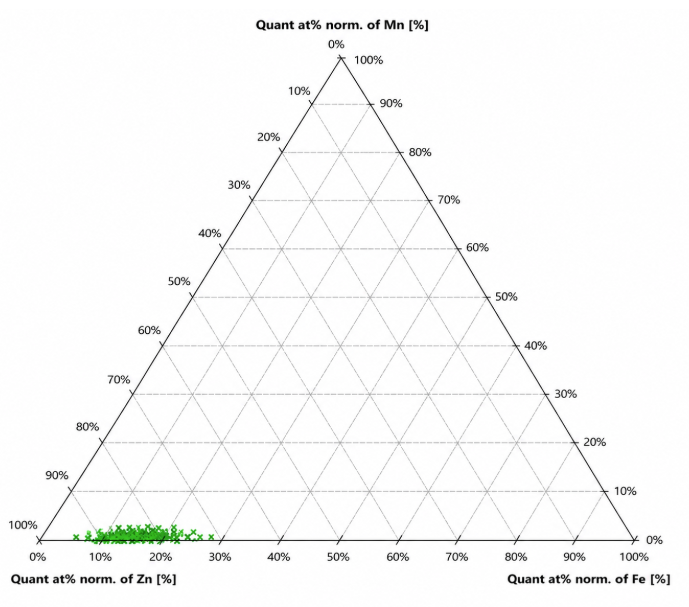
  • Detect low-abundance phases and complex textures
  • Compare ore types and concentrate products
  • Validate bulk analytical results with spatial data

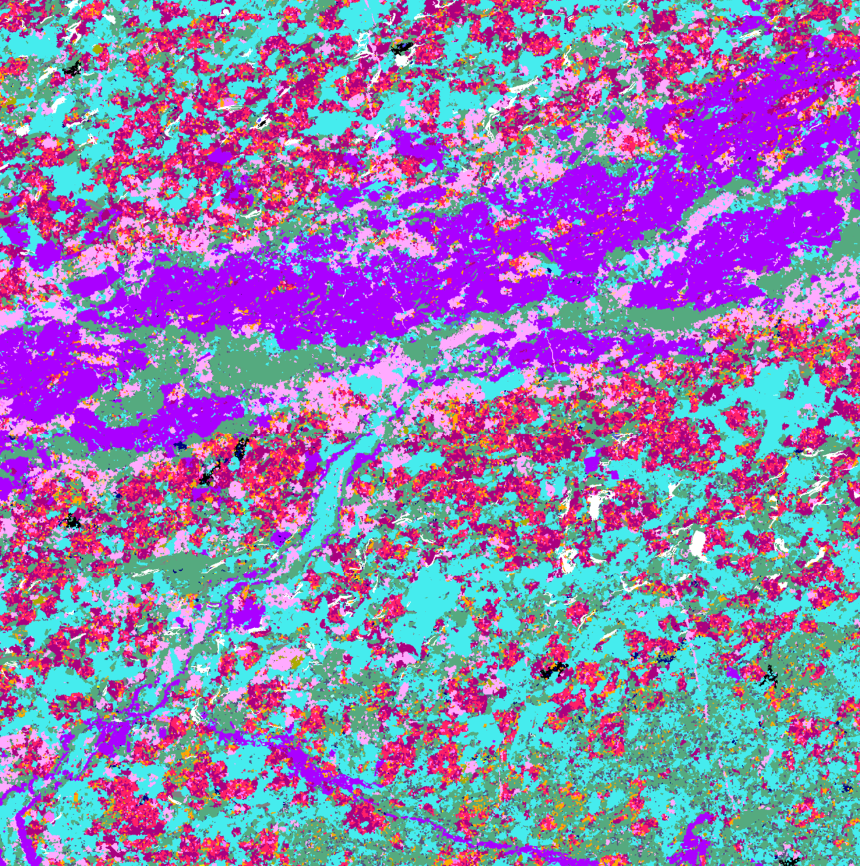
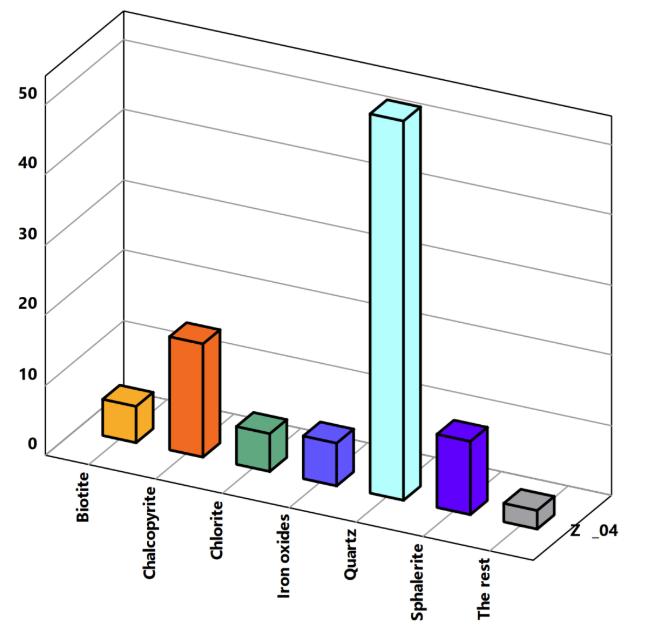
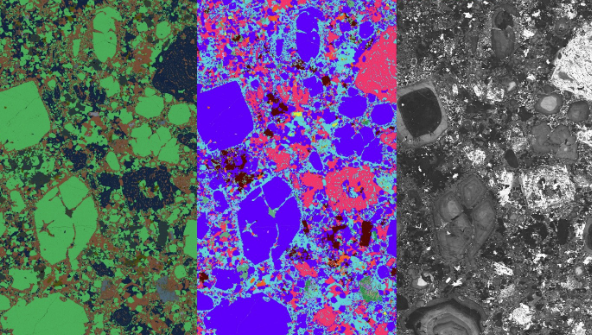
Automated mineralogy offers compositional accuracy beyond bulk methods. TIMA identifies phases down to trace levels and provides critical textural context, enabling robust characterization of ore types and processed materials.

Evaluating Elemental Deportment for Processing Decisions

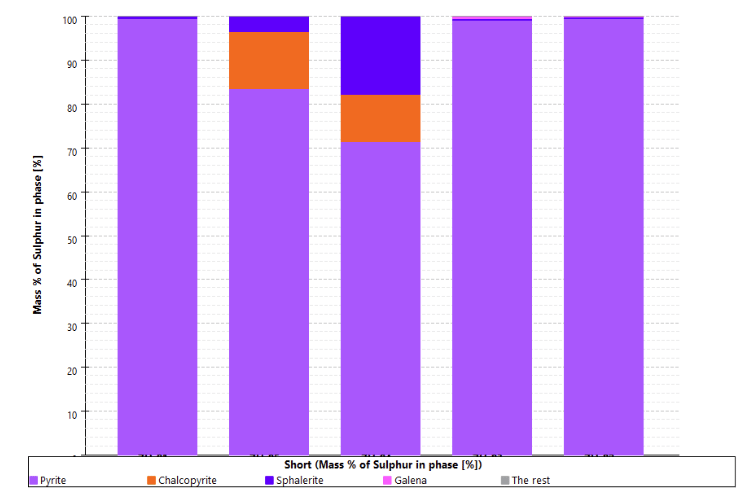
Determine where elements reside across mineral phases

  • Compare species hosting target elements
  • Analyze deportment across size fractions
  • Quantify deportment to sulphides, oxides, and other host speciesGuide flotation or leaching process selection

Elemental deportment clarifies whether elements like copper reside in sulphides, secondary phases, or native states. These insights support processing route selection and influence economic evaluation of ore types and blends.

Predicting Optimal Grind Size to Reduce Energy Demand

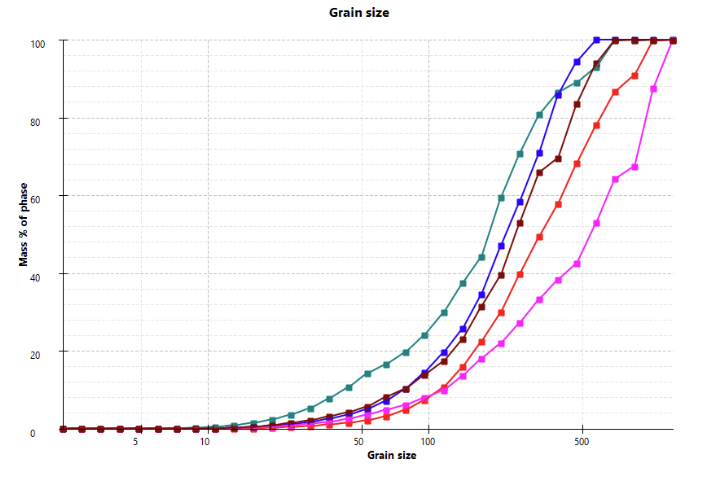
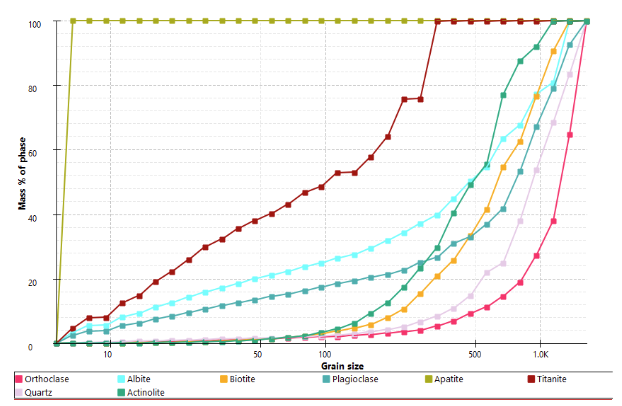
Link grain size distribution to comminution efficiency

  • Measure grain size of target minerals
  • Evaluate particle textures across the section
  • Predict optimal grind size for liberation
  • Reduce energy consumption in comminution

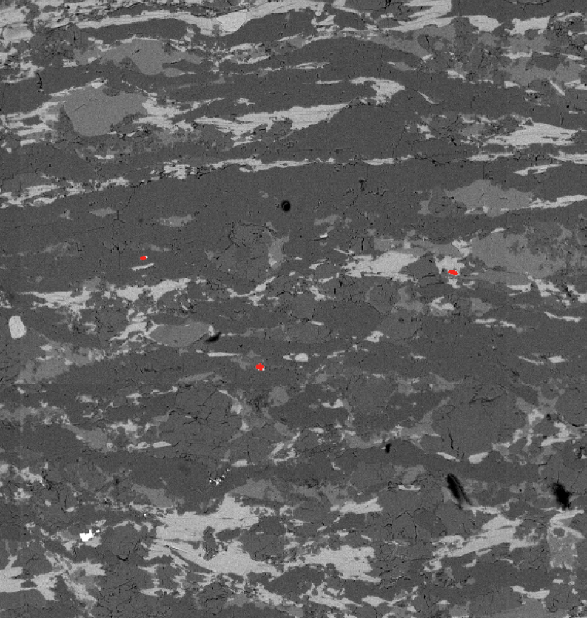
TIMA phase maps and grain size data support grinding optimization, helping operators avoid overgrinding and minimizing energy use— since comminution is one of the most energy-demanding stages of mineral processing.

Understanding Mineral Association and Locking

Determine how minerals occur and interact within the ore

  • Identify associations between value minerals and gangue
  • Evaluate inclusions, rims, and composite textures
  • Quantify particle locking characteristics
  • Support separation and reagent strategies

Association analysis reveals how target minerals—such as gold—interact with sulphides or gangue. These data are essential for designing effective flotation, leaching, and comminution strategies.

Tracking Target and Penalty Elements Across Streams

Monitor element variability across grains and process stages

  • Analyze grain-level element distribution
  • Track variability across size fractions
  • Integrate with metallurgical sampling structures
  • Reconcile mineralogical vs. chemical assays
TIMA enables detailed evaluation of variability across ore streams, ensuring no grain hosting critical or penalty elements is overlooked. This supports accurate mass balance models and reconciliation workflows 

ESSENCE – MICROSCOPE CONTROL SOFTWARE

Unified Control for SEM Imaging and Microanalysis

Essence™ brings imaging, navigation and analytical tools into one environment, supporting clear, consistent SEM workflows for materials scientists and inspection teams. Its streamlined layout and automation features help users move efficiently from first navigation to final verification.

  • Access spectra, maps, and profiles directly in the SEM window using integrated Essence™ EDSMaintain stable imaging conditions with In-Flight™ automated routines
  • Protect detectors and samples using the real-time 3D Collision Model
Unlocked content

Unlock
Tescan insight

leave a contact to access

Get the most out of Tescan

This is more than information; it's an advantage. We've compiled our technical whitepapers, detailed product flyers, and on-demand webinars to provide you with the knowledge that makes a real difference. Sign up now to access the insights you need to make an impact.

Tescan TIMA

FOR SEM SOLUTIONS TECHNICAL SPECIFICATIONS

TESCAN TIMA

Electron column 

High-brightness Schottky FEG with high-resolution imaging down to 1.2 nm at 30 kV

Resolution 

1.2 nm @ 30 kV (SE); 3.5 nm @ 1 kV(In-Beam SE); 1.8 nm @ 1 kV with sample bias 

Vacuum modes 

High-vacuum and SingleVac low-vacuum mode at (30 ± 10) Pa 

Stage 

5-axis motorized stage with 130 mm XY travel and up to 8 kg load capacity 

Chamber 

GM chamber with >20 ports and IR camera for sample viewing 

Sample holders 

Capacity for 15 epoxy blocks, 9 thin sections, or >40 blocks with optional high-capacity holder (* to state this holder requires extended frame and cradle stage)


Navigation 

Wide Field Optics™ for navigation from 2× magnification; Essence™ 3D Collision Model for protection 

EDS configuration 

Up to 4 EDS detectors (2 standard) 

SEM control 

Essence™ interface with automated beam alignment and In-Flight Beam Tracing™ 

Mineralogy modules 

TIMA Online & Offline, Liberation Analysis Module, Bright/Specific Phase Search Module 

Automation

Sample layout tools, automated calibration, adaptive analytical parameters, real-time data control

TESCAN TIMA

Electron column 

High-brightness Schottky FEG with high-resolution imaging down to 1.2 nm at 30 kV

Resolution 

1.2 nm @ 30 kV (SE); 3.5 nm @ 1 kV(In-Beam SE); 1.8 nm @ 1 kV with sample bias 

Vacuum modes 

High-vacuum and SingleVac low-vacuum mode at (30 ± 10) Pa 

Stage 

5-axis motorized stage with 130 mm XY travel and up to 8 kg load capacity 

Chamber 

GM chamber with >20 ports and IR camera for sample viewing 

Sample holders 

Capacity for 15 epoxy blocks, 9 thin sections, or >40 blocks with optional high-capacity holder (* to state this holder requires extended frame and cradle stage)


Navigation 

Wide Field Optics™ for navigation from 2× magnification; Essence™ 3D Collision Model for protection 

EDS configuration 

Up to 4 EDS detectors (2 standard) 

SEM control 

Essence™ interface with automated beam alignment and In-Flight Beam Tracing™ 

Mineralogy modules 

TIMA Online & Offline, Liberation Analysis Module, Bright/Specific Phase Search Module 

Automation

Sample layout tools, automated calibration, adaptive analytical parameters, real-time data control

TIMA 2

GET IN Touch

Contact us

map

Where you can find us:

Tescan Brno
Libušina třída 21
623 00 Brno
Czech Republic


info@Tescan.com