
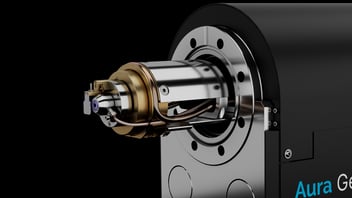
BIB milling uses a broad argon ion beam to remove specimen material through sputtering, supporting cross-section preparation and surface polishing.
Listen to article
Electron microscopy reveals fine structural details, but reliable results depend on the quality of the sample preparation that exposes the features of interest while preserving their original structure. Surface deformation, contamination, and other preparation-induced artifacts can obscure the surface and make the results more difficult to interpret.
-
How can sample preparation reveal the region of interest without altering its original structure?
-
Why is gentle polishing needed, and how can it improve the final surface quality?
-
How can it be integrated into the microscopy workflow?
Tescan’s AURA Gentle Ion Beam (GIB) technology is based on the sputtering principle used in ion milling. It enables controlled material removal at low ion energies, with a particular focus on gentle final polishing and cleaning. Its applications extend from cross-section preparation to surface finishing for electron microscopy. Understanding these methods and how they can be combined helps researchers choose a preparation workflow for their analytical goals.
Working principles of ion milling
Ion milling uses a beam of accelerated ions to remove material from a sample surface. This process relies on sputtering, where energized ions eject surface atoms via momentum transfer.
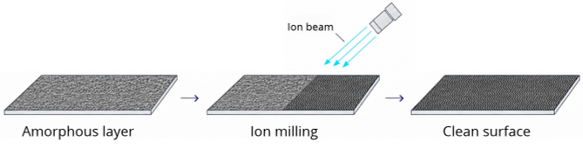
The ion energy can be adjusted to suit the material and preparation goal. Higher energies generally enable faster material removal, while lower energies allow finer surface refinement during the final polishing stage and help limit ion-induced damage.
There are two approaches to ion beam sample preparation: the focused ion beam (FIB) and the broad ion beam (BIB) techniques.
Focused ion beam (FIB) techniques enable precise, nanometer-scale milling, with high current, which introduces a higher risk of surface damage.
Broad ion beam (BIB) techniques are typically used to prepare larger areas and operates at lower ion energies, which decreasing beam damage.
Learn more: Why Automation Is Only Half the Story in TEM Lamella Preparation
Why the final surface matters
Atomic-scale samples require bigger attention and a more detailed approach. In transmission electron microscopy (TEM), the thin lamella must also preserve the structure of interest for reliable imaging and measurements.


In the case of FIB preparation, it has a significant risk of gallium contamination and beam-induced artifacts (ripples, grooves, damage) due to ion penetration. However, it could be improved with low-energy Argon.
Low-energy argon polishing able to remove amorphous, damage, and contaminations, including gallium implantation. Also, chemically inert Argon helps avoid the chemical interactions associated with gallium.
This final preparation step can improve the visibility of the underlying structure for high-resolution imaging and analysis.


Using GIB for FIB-prepared TEM specimens
GIB is used to remove a thin surface layer that interferes with analysis, while limiting the introduction of ion-induced damage. This typically serves as a final step following the primary milling process.
Tescan’s AURA Gentle Ion Beam applies this approach to the final polishing of FIB-prepared TEM specimens, with argon ion energies down to 200 eV. Its broad beam treats the lamella surface, helping reduce residual preparation damage before analysis.


GIB therefore complements the earlier preparation steps: FIB provides access to a selected region with high accuracy and shapes the lamella; GIB subsequently refines its surface. The two techniques address successive requirements within the same preparation workflow.
Learn more: Discover why low-energy argon ion cleaning is important for high-quality S/TEM specimen preparation.
Bringing gentle polishing into the microscope workflow
The AURA Gentle Ion Beam integration developed by Technoorg Linda for Tescan, brings low-energy argon polishing directly into Tescan’s AMBER™ 2 and SOLARIS™ 2 FIB-SEMs. The argon source is integrated into the microscope chamber at the FIB/SEM coincidence point, where the electron and focused ion beams meet. This enables final polishing of the prepared lamella inside the microscope while keeping the sample under vacuum.
For researchers, this also eliminates the need to transfer the sample to a separate argon ion polishing instrument. The lamella can remain on its holder during final treatment, reducing handling and avoiding exposure to ambient conditions between FIB finishing and argon ion polishing. This helps reduce the risk of mechanical damage, contamination, and oxidation.
The integration also extends to the microscope’s operating software. Through Tescan Essence™, users can configure polishing steps or use predefined recipes, keeping final cleaning within the same software environment as the preceding preparation stages. Recipe-based operation helps standardize treatment across specimens and operators.
After polishing, STEM-in-SEM provides an initial quality check before transferring the sample for TEM analysis. Researchers receive feedback while the lamella is still inside the FIB-SEM, allowing them to identify preparation issues earlier. Together, in-chamber treatment and integrated controls make the transition from FIB preparation to gentle finishing easier to manage.
Learn more: Explore how FIB-SEM automation and final polishing work together for reliable TEM lamella preparation
Choosing preparation around the analytical question
Ion milling’s value lies in how it prepares the samples for the next measurement. Selecting a workflow means considering the region of interest, the material’s response to preparation, and the surface condition needed for analysis.
Within that workflow, AURA GIB connects broad ion beam milling technology with the demands of final surface finishing. Integrating this step into the FIB-SEM helps researchers preserve specimen quality through all stages of preparation, and STEM-in-SEM allows for assessing the final results before proceeding to TEM analysis.
Written by Zoltán Herceg & Liubov Herceg
Application specialists, Technoorg Linda



Related Resources
AURA™ Gentle Ion Beam
Low-energy Ar⁺ polishing for high-quality TEM specimens.

Ultra-Thin TEM Lamella Preparation
See integrated FIB-SEM and Ar⁺ polishing in action.

Ar⁺ Polishing for TEM Samples
Explore gentle ion polishing for TEM sample preparation.