
How does a beetle keep the gap around its neck clean? At Ansbach University of Applied Sciences, Philipp Häfner and his colleagues have been investigating the structures behind this mechanism using scanning electron microscopy.
Their work with the Tescan CLARA™ also extends to polymer research with regional companies, connecting the study of natural structures with practical questions about materials and surfaces.
Examining a natural cleaning mechanism
The beetle research began in 2010. “The research was originally initiated in collaboration with the late Professor Reimann, who was a co-inventor of the underlying concept and led the laboratory at the time.”
Häfner continues to explain how the arrival of the Tescan CLARA™ supported a closer examination of its anatomy: “And now with a new Clara machine, we started to get high resolution pictures of this special area on this bug.”
The area of interest is the gap between the beetle’s head and body. Häfner describes Y-shaped hairs that seal this gap, together with a sawtooth profile around the neck. He explains that these structures work with the movement of the beetle’s head to transport particles outwards.
“So the beetle keeps his house clean,” he says.
The images enabled the team to examine the fine structures involved, supporting their investigation of how the hairs, surface profile and movement work together.
Investigating polymer surfaces with the Tescan CLARA™
Understanding surface behavior is also central to Häfner’s work with local industry. As he explains: “I do a lot of polymer research with companies next to our city.”
This work includes analyzing defects in plastics, alongside investigations involving surface technology and plasma modification. For sensitive polymer surfaces, Häfner describes using the low voltage imaging capabilities of the Tescan CLARA™.
He explains that coating these samples can sometimes conceal the defects they need to examine. Working at low voltage allows his team to investigate the uncoated surfaces while keeping those features available for analysis.
Describing the instrument’s performance in this work, he says the Tescan CLARA™ “is working pretty well with these challenges.”
Understanding how bacteria attach to surfaces
This interest in surface interactions also runs through Häfner’s broader research, which has included investigating how individual bacteria attach to surfaces. He describes a physical approach aimed at reducing bacterial adhesion without damaging the bacteria.
Part of this research involved measuring the adhesion force of individual bacteria to better understand their attachment to surfaces.
Häfner recalls presenting the results at IMC19 in Sydney and receiving encouraging feedback from the scientific community. Reflecting on his university’s contribution to fundamental research, he says:
“For our small university, I am very proud to do this scientific work and do some fundamental research.”
Connecting observation with application
The beetle study raises a practical engineering question: could the same cleaning principle help keep moving components clean? The Tescan CLARA™ gave Häfner and his colleagues a closer view of the structures involved. Their ambition was to use that understanding to develop a technical application, carrying the research, in his words, “from micro to macro”.
About Philipp Häfner
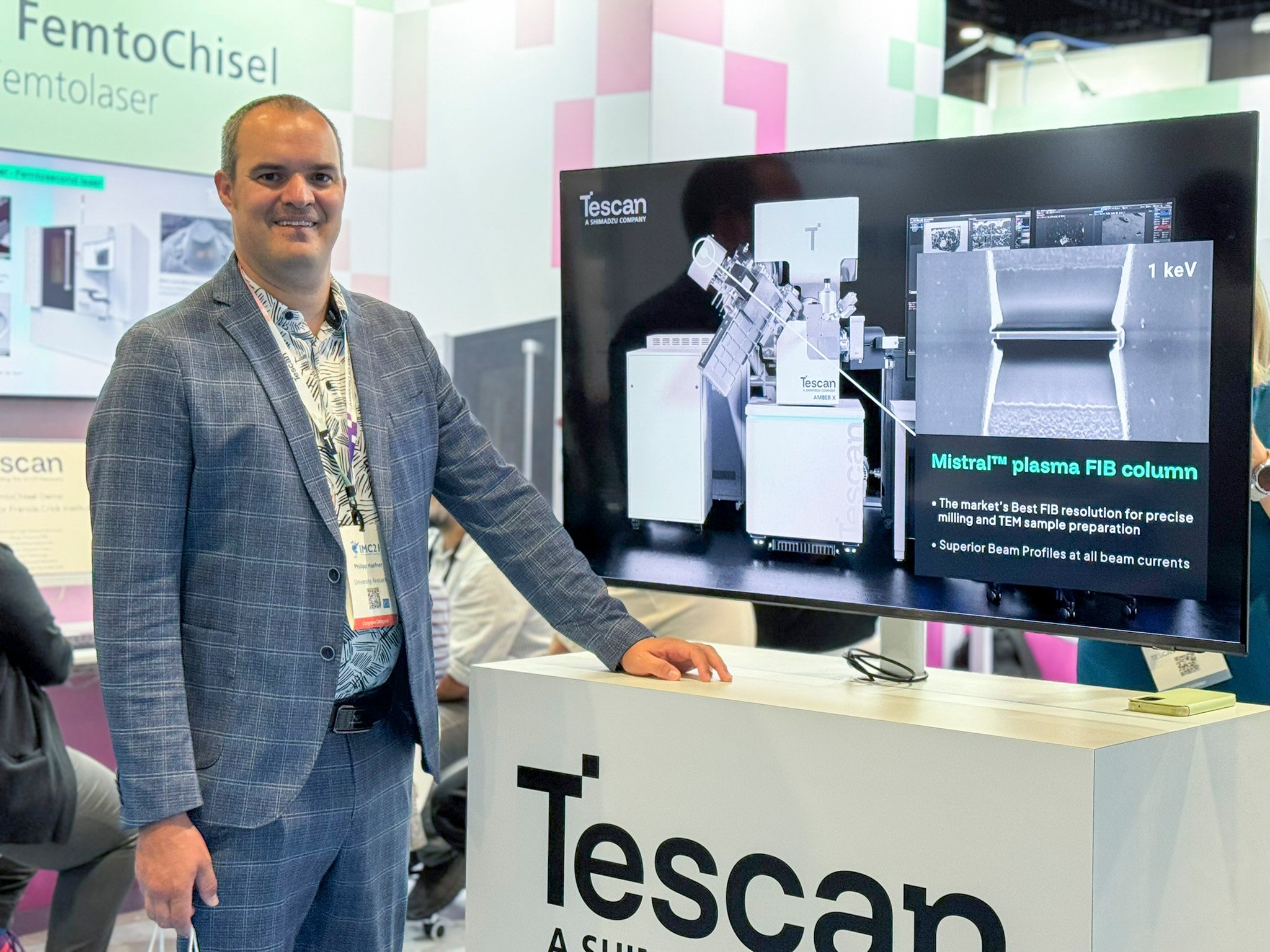
Philipp Häfner is a Research Officer and Laboratory Engineer in the Faculty of Engineering at Ansbach University of Applied Sciences, where he also supervises the scanning electron microscopy laboratory. His fields of activity include plastics and surface technology, plasma technology, and surface analysis.
His research portfolio includes investigating natural cleaning mechanisms in beetles for potential engineering applications, measuring bacterial adhesion to surfaces, and conducting plastics research.
Written by Sepideh Koubjari, Ph.D.
Content Marketing Specialist, Tescan


Related Resources
Learn more about the New Tescan CLARA™
Explore advanced imaging and contrast with the new CLARA™.

Tescan CLARA™
Ultra-high-resolution SEM for advanced materials analysis

Submit Your Sample for Advanced Contrast SEM Analysis
Improve sample analysis with advanced SEM contrast.