
Electron microscopy can sound intimidating at first.
Terms like electron beam, secondary electrons, or focused ion beam often make scanning electron microscopy feel highly specialized and difficult to understand unless you are already an expert in the field.
But the core principle behind a scanning electron microscope, or SEM, is actually surprisingly intuitive.
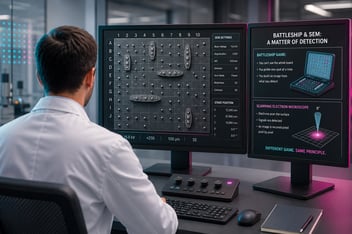
In many ways, it works like the classic game Battleship.
From Battleship to Electron Microscopy
If you remember playing Board Game Battleship, the process was simple.
You started with an empty grid.
You selected coordinates one point at a time.
And gradually, hidden structures began to appear.
At the beginning, you could not see anything. But with every move, the picture became clearer.
A scanning electron microscope works in a very similar way.
Instead of scanning an ocean grid, SEM scans the surface of a sample using a highly focused beam of electrons.
And just like in Battleship, it works systematically:
- Starting in one corner
- Moving point by point
- Row by row
- Gradually covering the entire area
This process is called raster scanning, and it is one of the fundamental principles of scanning electron microscopy.
SEM Does Not Take a Photograph
One of the most common misconceptions about SEM is that it simply “takes a picture.”
In reality, SEM builds an image gradually by collecting signals from individual points on the sample surface.
At each point, the electron beam interacts with the material and generates a response.
Some areas produce a strong signal.
Others produce a weaker one.
The microscope converts these signals into brightness values:
- Stronger signal → brighter pixel
- Weaker signal → darker pixel
The final SEM image is therefore not a traditional photograph.
It is a highly detailed map of how the material responds to the electron beam across the scanned surface.
This is one of the reasons SEM can reveal structures far beyond the limits of optical microscopy.
What Happens When the Electron Beam Hits the Sample?
When electrons strike the sample surface, several different signals can be generated simultaneously.
Different detectors inside the microscope collect these signals and transform them into different types of information.
This is where SEM becomes much more powerful than a simple imaging tool.
Imagine if Battleship could tell you not only that you hit something, but also:
- How large the object is
- What material is it made of
- What shape does it have
- How it is oriented beneath the surface
That is essentially what SEM detectors allow researchers to do.
Some detectors reveal surface topography and fine details. Others provide compositional contrast and information about material differences.
The same location on the sample can therefore be visualized in multiple ways, depending on which signal is being collected.
Understanding SEM Signals
Two of the most important signals in Scanning Electron Microscopy are secondary electrons and backscattered electrons.
Secondary Electrons (SE)
Secondary electrons come from the very top surface of the sample.
They are mainly used to reveal:
- Surface texture
- Fine morphology
- Nanoscale structures
- Fracture details
- Surface roughness
This signal produces highly detailed, almost three-dimensional appearance commonly associated with SEM imaging.
Backscattered Electrons (BSE)
Backscattered electrons originate deeper within the material and carry compositional information.
Different materials reflect electrons differently depending on their atomic number, creating contrast between phases and structures.
This makes BSE imaging especially useful for:
- Metallurgy
- Semiconductor analysis
- Ceramics
- Composite materials
- Failure analysis
Together, these signals help researchers understand not only what a structure looks like, but also what it is made of.
One Step Further: What Is FIB-SEM?
Traditional SEM allows researchers to analyze surfaces in extraordinary detail.
But what if you want to see what is hidden underneath?
This is where FIB-SEM becomes important.
FIB-SEM stands for Focused Ion Beam Scanning Electron Microscopy.
In addition to the electron beam used for imaging, the system also includes a focused ion beam that can precisely mill or cut into the sample surface.
Returning to the Battleship analogy:
Imagine not only detecting the ship, but also being able to cut through it and observe its internal structure.
That is the principle behind FIB-SEM.
Researchers use FIB-SEM for:
- Cross-section analysis
- Semiconductor failure analysis
- TEM sample preparation
- 3D tomography
- Nanoscale structural investigation
This combination of imaging and precise material removal makes FIB-SEM one of the most powerful tools in advanced materials characterization.
Why SEM Matters Across Modern Research?
Scanning Electron Microscopy is used across an enormous range of scientific and industrial fields.
Researchers rely on SEM to study:
- Advanced materials
- Semiconductors
- Batteries
- Biomaterials
- Nanoparticles
- Aerospace alloys
- Additive manufacturing structures
The reason is simple:
Many critical material properties are controlled by structures too small to be seen with conventional optical microscopes.
SEM helps make these hidden structures visible.
And once researchers can see them, they can better understand:
- Why materials fail
- How processing changes microstructure
- How surfaces interact
- How to improve material performance
From Tescan VEGA™ to Advanced FIB-SEM Solutions
At Tescan, electron microscopy has always been about making complex analysis more accessible and more practical for real scientific work.
One of the company’s defining milestones was the introduction of the Tescan VEGA™ series, which helped bring versatile SEM imaging into research laboratories, universities, and industrial environments worldwide.
Today, Tescan develops a broad portfolio of SEM and FIB-SEM systems supporting:
- Materials science
- Life sciences
- Semiconductor research
- Battery development
- Nanotechnology
- Failure analysis
- 3D characterization workflows
From routine imaging to advanced nanoscale analysis, Tescan technologies help researchers explore structures that would otherwise remain invisible.
Understanding Electron Microscopy Starts with Curiosity
Scanning Electron Microscopy may sound highly technical, but its core idea is remarkably simple:
Scan the surface point by point and build an image from the material’s response.
Much like Battleship, the full picture appears gradually.
But instead of revealing ships on a grid, SEM reveals the hidden architecture of the material world.
Written by Rostislav Vana
Head of Applications - SEM/FIB, Tescan


Download Related App Notes