
A recent study published in Food Packaging and Shelf Life investigated how thermal aging affects natural and agglomerated cork stoppers exposed to water and ethanol. To simulate accelerated aging, researchers exposed cork samples to water or ethanol at 50°C for 200 days before evaluating their response to repeated compression cycles. The study combines cork stopper aging, compressive testing, scanning electron microscopy (SEM) imaging, and microstructural analysis to better understand how long-term liquid exposure changes cork structure and performance.
Water and ethanol exposure played a central role in the thermal aging behavior of the cork stoppers. The study showed that both liquids are readily sorbed and imbibed into cork-based materials over time, meaning they are taken up by the material and drawn into its porous structure. After aging, liquid water occupied approximately 45-81% of the volume of cork-based stopper samples, while ethanol occupied approximately 79-88% of the volume. These interactions also led to swelling, particularly under liquid exposure conditions.
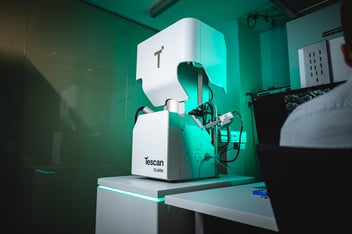
To investigate the cork microstructure after thermal aging, the researchers used a Tescan CLARA™ field-emission scanning electron microscope (FEG-SEM). SEM observations were performed at an accelerating voltage of 0.5 kV, under controlled low-vacuum conditions (+4°C, 500 Pa), using a gaseous detector. The cork samples did not require metallization prior to imaging, simplifying sample preparation and enabling direct observation of the aged cork surface.
The SEM imaging results provided valuable microstructural context for the mechanical testing data. In natural cork samples aged by complete immersion in water or ethanol, researchers observed delamination between cork cell walls following repeated compression testing. In samples immersed in ethanol, additional cell-wall degradation features were observed that were not present in water-aged samples, suggesting that ethanol interacts differently with cork under accelerated aging conditions.
Mechanical testing showed that thermal aging can alter the compressive behavior of cork-based stoppers. Complete immersion in water increased stiffness across all cork types tested, while ethanol immersion increased stiffness in agglomerated cork but had no significant effect on natural cork. Ethanol vapor exposure did not significantly affect stiffness in any cork type. By combining repeated compression testing with SEM analysis, the study linked changes in cork stopper performance to observable microstructural changes.
This work shows how carefully designed mechanical testing, supported by low-voltage and low-vacuum SEM imaging, can reveal how thermal aging affects cork-based materials at the microscale. Using CLARA™, the researchers were able to connect changes in compressive behavior with visible cork microstructure features, including cell-wall delamination and degradation after liquid exposure. Their study adds useful insight into how water and ethanol influence the durability and performance of cork stoppers, while showing how electron microscopy can support materials research where subtle surface changes need to be observed without extensive sample preparation.
Reference
Gerometta, M., Gabrion, X., Lagorce, A., Bonnotte, A., Villette, F., Thibaud, S., & Karbowiak, T. Effects of thermal ageing in water and ethanol environments on the compressive response of natural and agglomerated cork stoppers. Food Packaging and Shelf Life, 2026.
Written by Sepideh Koubjari, Ph.D.
Content Marketing Specialist, Tescan


Related Resources
Learn more about the New Tescan CLARA™
Explore advanced imaging and contrast with the new CLARA™.

Tescan CLARA™
Ultra-high-resolution SEM for advanced materials analysis

Submit Your Sample for Advanced Contrast SEM Analysis
Improve sample analysis with advanced SEM contrast.