Successful cryogenic analysis requires more than keeping a specimen cold. Sample transfer, electron dose, ice contamination, and acquisition conditions must all be carefully controlled to preserve material integrity and produce reliable data.
Controlling these factors is particularly important for scientists working with polymers, organic materials, nanoparticles, nanowires, zeolites, MOFs and COFs, perovskites, biomaterials, and other beam-sensitive samples.
In this on-demand webinar, you will explore the cryo workflow on Tescan TENSOR™, from holder cooling and sample loading to low-dose navigation and multimodal data acquisition. Learn how near-UHV column conditions and software-guided low-dose procedures help limit ice contamination and unnecessary beam exposure. Application examples demonstrate how imaging, compositional, and diffraction data can be acquired on a single integrated platform, providing complementary insights into beam-sensitive materials.
Why This Matters
For beam-sensitive materials, cryogenic conditions can help preserve structural and chemical information that might otherwise be altered during analysis. However, this protection must be maintained throughout the complete workflow, from sample loading and transfer to navigation and data acquisition.
Tescan TENSOR™ addresses these challenges through software-guided low-dose procedures, near-UHV column conditions, and a streamlined cryo-holder workflow. Together, these capabilities help preserve sample integrity, limit unnecessary beam exposure and ice growth while supporting stable, long-duration analytical experiments.
What You Will Learn
-
How the new cryo-EM solution brings cryo-STEM, cryo-EDS, cryo-4D-STEM, and cryo-3D ED to beam-sensitive materials on Tescan TENSOR™
-
How the cryo-holder is cooled, loaded, and transferred into the microscope while maintaining the sample at cryogenic temperature
-
How TENSOR™ simplifies cryo-holder insertion and reduces the risk of liquid nitrogen spillover during sample transfer
-
How software-guided low-dose procedures help minimize unnecessary beam exposure during analysis
-
How near-UHV column conditions help minimize ice growth and enable extended cryo-EDS and multimodal analysis
-
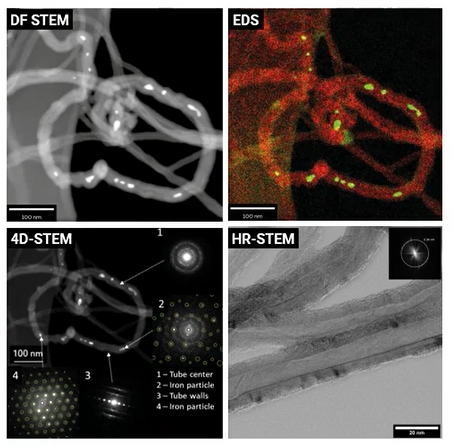
How cryo-STEM, cryo-EDS, and cryo-4D STEM are applied in case studies of iron and coated TiO₂ nanoparticles
Register to access the on-demand webinar and explore how Tescan TENSOR™ can support low-dose cryo-STEM and cryo-4D STEM analysis of beam-sensitive materials and expand what is possible in materials science research.