
How do you look inside an object without cutting it open?
For researchers and engineers, that question appears everywhere. Electronic devices contain densely packed components hidden beneath protective housings. Batteries rely on complex internal structures that determine performance and lifetime. Even everyday objects contain features and processes that cannot be seen from the outside.
Micro-CT provides a way to explore these hidden worlds. By using X-rays to create detailed three-dimensional representations of an object's internal structure, micro-CT allows scientists and engineers to investigate materials, components, and assemblies without disassembly or damage.
Learn more about non-destructive X-ray CT in our interview with Riley Tejcek.
To understand how the technique works and why it has become so valuable across science and industry, let us examine a familiar object: the Bialetti moka pot. What begins as a simple coffee maker quickly becomes a useful demonstration of how micro-CT can reveal information across multiple scales, from complete systems to microscopic structures, and even capture changes over time.
Seeing the Whole Picture: Imaging an Entire Moka Pot
At first glance, a moka pot seems simple. Water is heated in the lower chamber, pressure pushes it through a bed of coffee grounds, and brewed coffee collects in the upper chamber.
VIDEO 1 - Coffee multiscale
Yet much of what makes the device function is hidden from view.
Inside are channels, filters, valves, threaded connections, and sealed interfaces that work together as a complete system. Understanding how these elements interact would normally require disassembly, which removes important context and alters the original assembly.
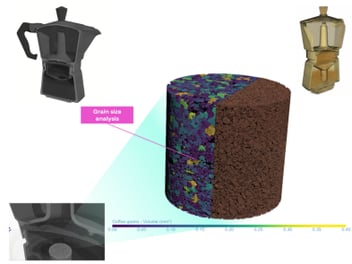
A whole-object micro-CT scan offers a different perspective. Rather than examining individual parts, researchers can visualize the entire moka pot as a single three-dimensional dataset (see Video 1). Internal and external features become visible simultaneously, while virtual cross sections can be generated in any orientation to explore regions that would otherwise be inaccessible.
This approach is particularly valuable for assembled products. Engineers can evaluate component fit, investigate material interfaces, identify hidden manufacturing features, and assess potential defects without damaging the object. Similar approaches are used in semiconductor packaging to evaluate thermally induced displacement and warpage.
The resulting dataset acts as a digital twin of the physical specimen. Instead of repeatedly sectioning or dismantling the sample, researchers can navigate through the reconstructed volume and investigate areas of interest as needed.
The same principle applies far beyond coffee makers. Similar workflows are used to study electronic assemblies, medical devices, geological samples, aerospace components, and cultural heritage artifacts. In each case, the goal is the same: reveal internal structures while preserving the original object. These capabilities are also being applied in life sciences research, where micro-CT helps researchers study embryonic and fetal development while preserving valuable biological specimens.
Zooming In: Exploring the Coffee Bed at High Resolution
One of the strengths of micro-CT is its ability to investigate structures across multiple length scales.
After scanning the entire moka pot, attention can shift to one of its most important components: the coffee grounds themselves.
At higher magnification, the coffee bed becomes a complex landscape of particles, pores, and interconnected pathways. What appears uniform to the naked eye is actually a highly heterogeneous structure (see Video 1).
Micro-CT enables researchers to measure particle size distributions, evaluate particle shapes, and analyze how particles pack together. Empty spaces between particles can also be characterized, revealing the pore network through which water travels during brewing.
These microscopic details directly influence flow behavior. Densely packed regions may restrict fluid movement, while larger pores can create preferential pathways. Variations in particle arrangement can affect extraction efficiency, pressure distribution, and overall brewing performance.
Although coffee provides an intuitive example, the same questions arise throughout science and engineering. Powder processing depends on understanding particle packing. Battery researchers investigate porous electrode structures that influence ion transport. Pharmaceutical scientists study tablet porosity and drug delivery pathways. Additive manufacturing specialists evaluate powder quality before printing.
In each case, micro-CT transforms hidden geometries into measurable data, helping researchers connect internal architecture with functional performance.
When Time Matters: From 3D Imaging to 4D Imaging
So far, the examples have focused on static structures. A micro-CT scan captures an object at a specific moment in time.
Many scientific questions, however, involve processes rather than snapshots.
VIDEO 2 - Coffee dynamic
How does fluid move through a porous material?
How does a component degrade during use?
How do structures evolve under heat, stress, or chemical exposure?
Answering these questions requires more than a single three-dimensional image.
This is where 4D imaging comes into play, with the fourth dimension being time. By acquiring a sequence of three-dimensional scans throughout an experiment, researchers can observe how structures change and evolve. Instead of analyzing a single volume, they study a series of volumes that reveal dynamic behavior.
The moka pot once again provides a useful example (see Video 2).
Imagine performing repeated micro-CT scans during the brewing process. As water moves through the coffee bed, researchers could observe how saturation develops in different regions. Fluid pathways could be tracked as they emerge and change. Variations in flow behavior could then be linked directly to differences in particle packing and pore structure observed in the earlier scans.
What was previously hidden becomes visible as a process unfolding inside the object.
The resulting information goes beyond simply identifying where fluid travels. Researchers can investigate transport rates, identify bottlenecks, observe structural changes, and better understand how local features influence overall system behavior.
Why 4D Imaging Matters
The ability to observe change over time is opening new possibilities across science and engineering.
Materials scientists use time-resolved imaging to study crack initiation and growth. Geoscientists investigate how fluids move through rocks and soils. Manufacturing researchers observe structural evolution during processing and heat treatment. Battery developers examine degradation mechanisms that occur during repeated charging and discharging.
The underlying challenge is remarkably similar to what happens inside the moka pot. In each case, researchers are trying to understand how structures influence dynamic processes. Static images reveal what something looks like. Time-resolved imaging reveals how it behaves.
This shift from observation to process understanding represents one of the most important developments in modern micro-CT imaging
From Everyday Objects to Scientific Discovery
The Bialetti moka pot may seem far removed from advanced research laboratories, yet it demonstrates many of the fundamental strengths of micro-CT.
A whole-object scan reveals the complete internal architecture without disassembly. High-resolution imaging exposes microscopic details within the coffee grounds, including particles, pores, and flow pathways. Extending the experiment into the time domain transforms the technique into a 4D tool capable of capturing dynamic processes as they occur.
The same principles apply whether the subject is a coffee maker, a battery electrode, a pharmaceutical tablet, or a biological specimen. Micro-CT enables researchers to investigate hidden structures non-destructively, move seamlessly across scales, and gain insights that would otherwise remain inaccessible.
As imaging technologies continue to advance, researchers are increasingly able to move from static visualization to observing real processes in action. Understanding not only what is inside an object, but also how it changes over time, is opening new opportunities across science and engineering.
What processes in your research could benefit from seeing inside materials in both 3D and over time?


Related Resources
Micro-CT Analysis of Semiconductor Package Warpage

Dynamic-to-Detail Micro-CT with Tescan UniTOM® HR 2

Dynamic Micro-CT of Crystal Growth During Cooling