
With the Winter Olympics approaching, we are revisiting our January 2025 conversation with Riley Tejcek, a Team USA bobsled pilot and United States Marine Corps captain who is also an author and Miss Military titleholder. Working across elite sport, active-duty leadership, and public speaking, Tejcek uses each platform to encourage young women to step confidently into roles where they remain underrepresented.
A Multi-Field Career in Male-Dominated Spaces
Riley Tejcek’s story is a tale of sports, service, personal ambition, and breaking the mold. She entered the United States Marine Corps without having seen women in that role growing up, then built a second career as a bobsled pilot after submitting an online tryout video in 2020.
Alongside training and active-duty commitments, she has also become an author. Her children’s book, “If You Can Dream It, Be It,” encourages young girls to picture themselves in careers and sports that may not have felt accessible.
Precision, Performance, and Safety: Non-Destructive Imaging for Reliable Performance
Bobsled is a sport defined by precision under pressure. Athletes push a sled weighing more than 170 kilograms before accelerating down an ice track where small decisions can determine the outcome of a run. In the Marine Corps, Tejcek applies the same focus to mission readiness, teamwork, and accountability.
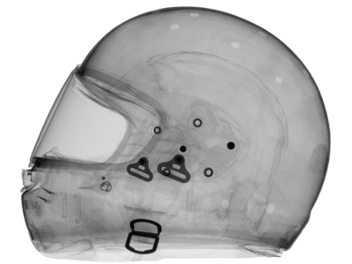
During one of her competitive seasons, Tescan supported Tejcek as a sponsor. Around the same time, her helmet was scanned using non-destructive 3D imaging in the Tescan UniTOM XL1, to better understand its internal structure without taking it apart. A full 3D overview made it possible to examine internal components and then focus on selected areas in more detail, revealing how layered fiber-reinforced materials create a casing that balances low weight with structural strength. Such materials inspection is especially important for safety-critical components that must perform reliably under extreme conditions.
In January 2025, we sat down with her for an interview to hear how she combines elite sport with a drive to push boundaries in fields that are still predominantly male-dominated.
Combining Careers
Q: How would you introduce yourself?
My name is Riley Tejcek. I am an active-duty United States Marine Corps captain, a member of Team USA Bobsled as a pilot, an author, and Miss Military 2023 and 2024.
Q: How did you get into bobsled?
I was not a bobsledder from a young age, despite what most people think. I was a collegiate softball player at George Washington University in Washington, D.C., and it wasn't until there that really sparked my interest in bobsled.
While I was there, a former alumna, a five-time Olympian in bobsled who also played softball at the same university, visited after winning a silver medal in 2018. When she spoke to my team, I was instantly drawn to the speed, the endorphins, the power - everything she had to say about bobsled.
At the time, I was focused on joining the Marine Corps. In November 2020, I saw an online bobsled tryout, submitted a video, and the rest is history.
Q: How did you decide to join the U.S. Marine Corps?
When I went to college, I had no idea I wanted to be a Marine Corps officer. I had never seen a female Marine, so I never thought it was possible.
When I was 18, I ran into a Marine recruiter by complete accident. I loved the idea of being a servant leader2 and doing something where not a lot of women were serving. I wanted to be one of the few, one of the proud, to represent my country, and to be physically fit.
I decided to join that day. My mom cried, knowing I was not coming home that summer. She thought it was a phase. It was not. Here I am now. Six years of active-duty service, one combat deployment, and continuing to serve for my country.
Bobsled came afterward. I was a Marine first. I went through training, and during the COVID era the schedule and remote work options made it possible to attend the bobsled tryout while still meeting my responsibilities, thanks to supportive leadership.
Q: How do you balance being in the military and bobsledding?
It is a constant challenge. My primary commitment is always being a Marine. At the same time, Marines are taught to strive for excellence and serve with discipline. Competing for Team USA at the highest level takes the same mindset. Being a Marine is one of the biggest life accomplishments I have ever had, but I am not going to stop there. I also want people to see that it is possible to pursue more than one path. Whether it is being a parent, going back to school, earning another degree, or competing in sports, I want to show people that you can do as many things as possible.
Q: Bobsled is an expensive, international sport. What kind of support helps make it possible?
Bobsled is one of the most expensive sports, especially in the United States. Imagine transporting two 400-pound (about 180 kg) bobsleds around the world. The sport is international, the season runs for months, and competitions take place across multiple countries, at some of the nicest ski resorts in the world.
Unlike some countries, U.S. athletes are not government-funded, so support from sponsors and partners is essential. Many athletes are competing year-round while managing financial constraints, and some even live below the poverty line. Unlike the MLB, NHL, or NFL, we rely heavily on people to step up and show up to support the little sport of bobsled. People often see bobsled every four years during the Olympics, but there are full seasons from October to March, all over the world. That ongoing support is what makes training and competition possible.
Q: Both in uniform and on the sled, equipment matters. What do you think about performance and safety?
In bobsled, we rely on equipment that performs in extreme conditions. I thank Tescan for sponsoring us with protective gear that helps us perform safely. Reliable equipment is essential for doing your best.
What many people do not realise is that the steel blades, called runners, on our sled experience up to five Gs, about five times the force of gravity, at around 90 miles per hour (about 145 km/h). I need the integrity of that steel to be pristine. Tescan’s instruments create the opportunity to inspect the steel and ensure it is in excellent condition. These tools help analyze materials and verify conditions. They are important, not only to keep us safe, but also to help us go faster.
That same mindset applies in the military. From protective equipment to anything we wear in the field, I want to know it will do its job, keep people safe, and help them return home.
Looking Ahead
Q: What message do you want to share with young girls following your journey?
A big reason I do this is to create impact, especially for young women. Growing up, I did not know these paths were possible. My goal is to show that you can pursue sport, military service, writing, or leadership roles, even in spaces where women are underrepresented. I even wrote a book about it, “If You Can Dream It, Be It.”
I am grateful to those who made this path possible before me, and I want to make it wider for those who follow.
We also asked Riley about her future plans at the time of our conversation.
I have a lot of big goals. I am always working toward the next thing. My goal was to do everything I could to become the first female Marine to compete in the Winter Olympics in Milan in 2026.
From a military standpoint, my next goal is to earn the rank of major and continue to inspire as a woman in leadership. I have written one children’s book, and I want to publish more. I also want to continue speaking to teenagers and adults of all ages about what is possible when you believe in yourself.
I also want to thank Tescan for believing in my journey and partnering with me.
Although Riley did not make the Olympic Team, she continues to cheer proudly for Team USA, remaining an inspiration to many.
1 An overview scan in the Tescan UniTOM XL, at a voxel size of about 150 micrometers, allowed us to examine the internal structure of the helmet, including components such as hinges and connectors. The system supports non-destructive 3D imaging of large samples while maintaining fine internal detail, which made it possible to move from a full 3D overview to selected areas of interest. ↩
2 Servant leadership (U.S. Marine Corps) refers to a leadership philosophy in which a Marine leader places the welfare, development, and mission effectiveness of their Marines above personal interest, using authority to serve others while upholding discipline, standards, and accountability. ↩
Written by Sepideh M. Koubjari, Ph.D.
Content Marketing Specialist, Tescan


