
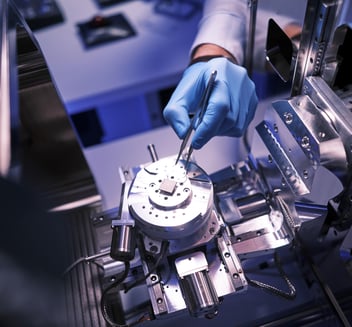
Discover why sample preparation is a crucial part of electron microscopy. Learn how cleaning, mounting, coating, drying and sectioning affect image quality and analysis, and how preparation workflows differ for solid samples, cross-sections, TEM lamellae, and biological or cryogenic specimens.
Introduction
High-quality electron microscopy results start with proper sample preparation. The way a specimen is transported, cleaned, mounted, dehydrated, or coated directly affects image quality, ease of analysis, and the ability to observe the area of interest.
In this guide, you will learn:
- What is sample preparation in electron microscopy and why it matters
- How samples are handled, cleaned, mounted and prepared for analysis
- What is conductive coating, when it is needed, and how it is applied
- How preparation differs for biological, wet, delicate and cryogenic samples
Whether you are just getting started with electron microscopy or revisiting the essentials, this overview explains the basic sample preparation concepts for reliable imaging and analysis.
What is sample preparation in electron microscopy?
Sample preparation is the set of steps used to make a specimen suitable for imaging. Depending on the material, this may include transport, labeling, cleaning, mounting, dehydration, thin-sectioning or conductive coating.
Why does sample preparation matter in electron microscopy?
Good sample preparation improves the chance of getting useful data from the first run. It helps reduce contamination, charging and handling damage, improves image quality, and supports faster, more reliable analysis.
How should samples be transported before analysis?
Samples should be transported in suitable containers that protect them from damage and contamination. Powder samples should be secured against spilling, and each specimen should be clearly labeled. It is also helpful to mark the area of interest in advance, so observation is faster and more precise.
Why is sample cleaning before imaging important?
Clean samples produce better results. They should be handled with gloves and tweezers and stored in a dry, dust-free environment. Before imaging, samples can be blown with compressed air or nitrogen. If more thorough cleaning is needed, the chosen approach should remove contamination without damaging or altering the surface.
Which cleaning methods are commonly used?
The right cleaning method depends on the material. Hard, nonporous inorganic materials such as metal surfaces can often be degreased with ethyl or isopropyl alcohol. Ultrasonic or plasma cleaning may also be used, depending on the type of contamination and the sensitivity of the surface.
How are samples mounted on a holder?
Samples are mounted on specimen holders using materials that should be water-free, vacuum-stable and electrically conductive, without contaminating or damaging the specimen. Double-sided carbon tape is a common and convenient option for many uncoated samples. Carbon or silver paint can provide better electrical contact, while screw-type holders are useful for larger specimens or for materials that should not be contaminated by tape or paint.
What if the sample is too large?
Large samples may need to be ground, fractured or cut into smaller pieces so they fit into the chamber and can be mounted safely.
How are cross-sections prepared for electron microscopy?
A cross-section is a prepared cut through a sample that reveals its internal structure. Depending on the material and the analysis goal, cross-sections may be prepared by cutting and polishing, by laser ablation (for example, Femtochisel), by broad ion beam (BIB) polishing for cleaner large-area sections, or by focused ion beam (FIB) milling when a very specific site must be exposed. For the highest-quality site-specific TEM lamella preparation, FIB milling may be followed by gentle low-energy ion polishing to reduce preparation-induced damage.
How are TEM lamellae prepared?
A TEM lamella is a very thin, electron-transparent section prepared for transmission electron microscopy (TEM) or scanning transmission electron microscopy (STEM). It is usually produced by focused ion beam (FIB) milling, which enables a specific region of interest to be cut out and thinned with high precision until electrons can pass through it. In advanced workflows, final low-kV polishing may be used to reduce preparation-induced damage and improve lamella quality. This makes the method especially useful for analyzing buried structures, interfaces and defects in semiconductors, metals, ceramics and other materials.
Why is conductive coating used?
Conductive coating creates a path between the specimen surface and ground, helping to reduce charge build-up during imaging. If the coating is thin enough, it can improve conductivity without masking important surface detail.
Do all samples need conductive coating?
No. Metals and metal alloys are often conductive enough, stable in vacuum and resistant to the electron beam, so they usually only need to be mounted on a suitable holder. Semiconductor samples, some minerals and many carbon-based materials often do not need coating either. Less conductive materials, including many biological, geological and ceramic samples, may require a thin conductive coating or specific imaging conditions.
Which coating materials are most common?
Common coating materials include gold, platinum, palladium, chromium and carbon. Gold is widely used, platinum and chromium are preferred for high-resolution imaging because they form finer grains, and carbon is often chosen for X-ray microanalysis or backscattered electron imaging.
How are conductive coatings applied?
Thin conductive films are usually deposited in vacuum using physical vapor deposition methods such as evaporation and sputtering. In practice, it is often best to start with a thinner coating and add more only if needed.
How are biological or water-rich samples prepared for electron microscopy?
Biological and water-rich specimens require special preparation because electron microscopes operate under vacuum. For scanning electron microscopy (SEM), fixation helps preserve their structure, while dehydration removes water before imaging. Because these samples are often less conductive, they may also require conductive coating or alternative imaging conditions such as low vacuum or low temperature.
For transmission electron microscopy techniques such as TEM and STEM, preparation goes a step further. After fixation and dehydration, the specimen is typically embedded in resin to support its structure and then cut into ultrathin sections, usually below 100 nm, so electrons can pass through it.
How are wet or delicate samples dried for SEM?
Wet or delicate specimens are usually not air-dried, because evaporation can distort fine structures as surface tension pulls on the material. Instead, they are often fixed, dehydrated through a graded ethanol or acetone series, and then dried by critical point drying (CPD). This helps preserve fine details by reducing the drying stresses that can damage delicate features. For relatively thin specimens, plunge-freezing followed by freeze-drying can also be used.
How does cryo-EM sample preparation differ?
Cryo-electron microscopy (cryo-EM) follows a different route from conventional biological TEM or STEM sample preparation. Instead of dehydration, resin embedding and ultrathin sectioning, the specimen is rapidly vitrified and imaged in the frozen state.
In single-particle cryo-EM, purified proteins, viruses or other biomolecules are typically applied to a TEM grid and plunge-frozen into vitreous ice before screening and data collection.
In cryo-electron tomography, larger or more complex specimens, such as whole cells or tissue regions, are first vitrified and then, if necessary, thinned into cryo-lamellae by cryo-FIB before 3D imaging in the TEM.


New product releases, application insights, and event updates.
Delivered as a quarterly newsletter with product news, insights, and events.