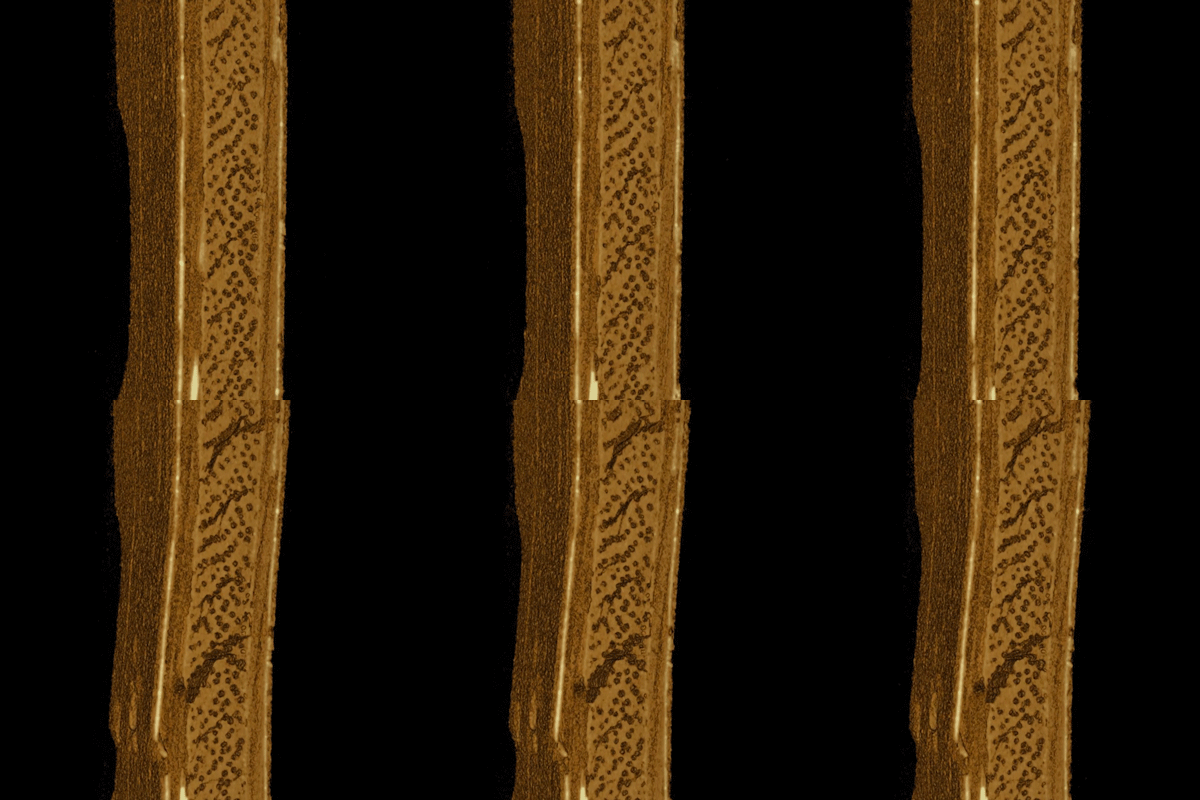
Move seamlessly from Dynamic to Detail
Multiple-detector workflows and volume-of-interest scanning allow users to transition directly from fast overview and/or dynamic imaging to sub-micron inspection within the same sample and hardware setup.

In-Situ Continuity for Dynamic-to-Detail discovery
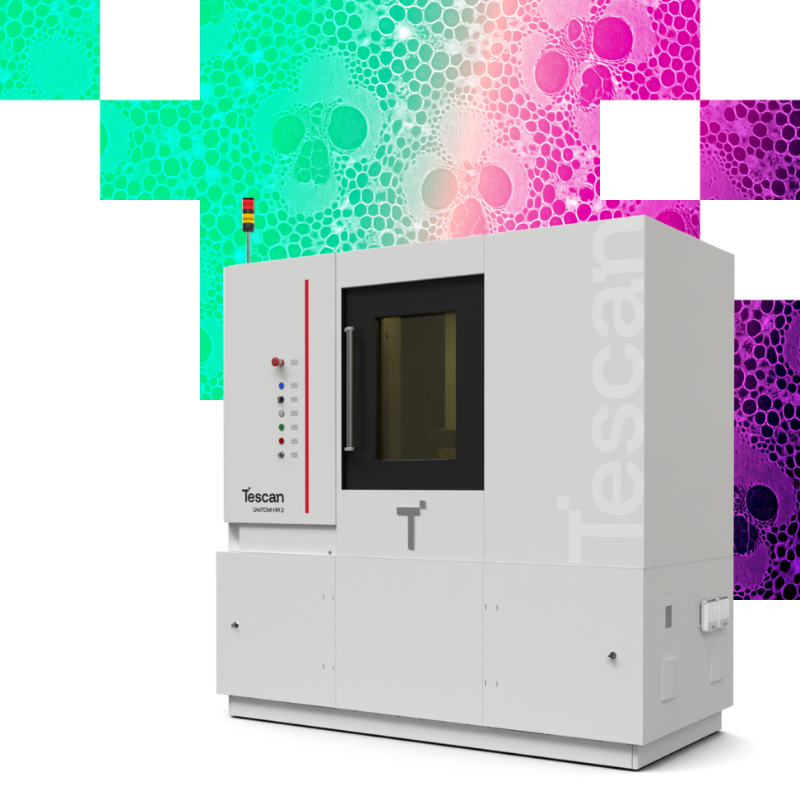
Tescan UniTOM® HR 2 is a dynamic micro-CT platform designed around one core concept: In-Situ Continuity.
You capture fast evolution, then switch to a sub-micron region of interest (ROI) detail without removing the sample or dismantling the in-situ stage.
With Volume of Interest Scanning (VOIS) and detector switching, the dataset stays correlated from the dynamic moment to the high-resolution explanation of the micro-mechanism.
Tescan UniTOM® HR 2 is a high-performance micro-CT platform designed around one core concept: In-Situ Continuity across scales and time.
Start with fast, large-field imaging to understand the whole sample, whether as a static overview or during an in-situ experiment, then move seamlessly to sub-micron region-of-interest detail without removing the sample or dismantling the experimental setup.
With Volume of Interest Scanning (VOIS) and seamless detector switching, datasets remain fully correlated as you transition from fast imaging to high-resolution inspection. The result is a continuous, reliable path from context to explanation, within the same sample, hardware configuration, and coordinate system.
Whether you are screening large samples, performing long in-situ studies, or capturing fast transient events, UniTOM® HR 2 ensures that no insight is lost between overview and detail.
High resolution matters, but it is only powerful when it arrives with the speed to capture the event and the field of view to keep context. UniTOM® HR 2 is built to help you move beyond headline specifications and focus on what determines outcomes: a workflow that shows the whole sample, records the change, and then reveals the root cause mechanism, all in one connected experiment.
Film the movie, capture the photograph.
Tescan UniTOM® HR 2 removes common friction points that slow research down: transferring samples between “fast” and “detail” systems, losing alignment between time points, manual filter swaps, and fast scans that are too noisy to trust. When configured with Panthera™ AI and the Automated Filter Changer, the workflow becomes more fluid and focused on results, not logistics.
Interrupted experiments break causality. In many workflows, teams run fast dynamic imaging in one configuration, then transfer the sample to a different setup for high-resolution inspection. That handoff introduces risk: the sample state can change, alignment is lost, and the chain of evidence weakens.
Tescan UniTOM® HR 2 is built to keep the sample in the in-situ environment through the full cycle. You capture the event, then immediately document the micro-mechanism that caused it, with the experimental context still intact.
The continuous workflow, step by step:
In one glance
Dynamic-to-Detail workflow: observe a critical event during the experiment, then move straight to ROI detail without moving or risking the sample.
™
AI, AI 4D denoising leverages 3D plus time (4D) to reduce the noise penalty in fast dynamic scans.
Non-destructive 3D characterization of pores, cracks, inclusions, fibers, interfaces, and other microstructural features, from whole-sample context to sub-micron detail
In-operando dynamic imaging captures deformation, crack initiation, phase changes, and failure processes as they evolve
VOIS™ enables targeted high-resolution imaging of regions of interest within larger samples, connecting dynamic events with detailed root-cause analysis
Tescan UniTOM® HR enables materials researchers to move from high-quality 3D characterization to dynamic experiments and targeted root-cause analysis in a single workflow. Users can first visualize and quantify the internal structure of intact samples in 3D, then observe how that structure changes under mechanical, thermal, or other experimental conditions. When a critical event appears, VOIS™ supports targeted high-resolution imaging of the region of interest without losing structural or experimental context. This dynamic-to-detail workflow helps connect microstructure, material behavior, and failure mechanisms.

Non-destructive 3D imaging of complex assemblies, interconnects, and bond interfaces
Time-resolved and in situ imaging supports reliability studies under thermal or mechanical stress, revealing deformation, warpage, crack initiation, and failure progression
VOIS™ enables targeted high-resolution imaging of critical regions, connecting package-level context with detailed root-cause analysis
Multi-detector configurations allow for versatile imaging workflows, from individual components and modules to consumer electronic devices and assemblies
Tescan UniTOM® HR enables semiconductor and electronics researchers to inspect internal package structures in 3D and investigate how reliability issues develop over time. Users can locate and quantify defects, interfaces, interconnects, and failure-critical features without destructive sectioning. For stress and reliability testing, dynamic imaging helps capture when and where structural changes occur, while VOIS™ allows users to zoom into the region of interest for high-resolution root-cause analysis. This creates a continuous workflow from package-level inspection to dynamic behavior to detailed failure mechanism.

Time-resolved imaging of electrodes, separators, and solid-state interfaces
Continuous rotation that enables uninterrupted charge–discharge observation
Multi-scale capability linking microstructural evolution to full-cell performance
Non-destructive 3D characterization of electrodes, separators, interfaces, pores, particles, coatings, cracks, voids, and internal defects
Time-resolved and in situ imaging follows structural changes such as swelling, cracking, delamination, deformation, and gas or void formation during cycling or stress testing
VOIS™ enables targeted high-resolution imaging of regions of interest, connecting cell- or electrode-level context with microstructural root-cause analysis
Tescan UniTOM® HR supports battery research from high-resolution 3D characterization to advanced dynamic and operando experiments. Researchers can first visualize and quantify the internal structure of intact cells, electrodes, and battery materials in 3D, including porosity, particle architecture, interfaces, cracks, voids, and manufacturing defects. During cycling, thermal exposure, or mechanical stress, time-resolved imaging helps reveal how these structures change and where degradation or failure begins. When a critical region is identified, VOIS™ enables targeted high-resolution imaging without losing experimental context, helping connect battery design, degradation behavior, and the microstructural mechanisms behind performance and safety.
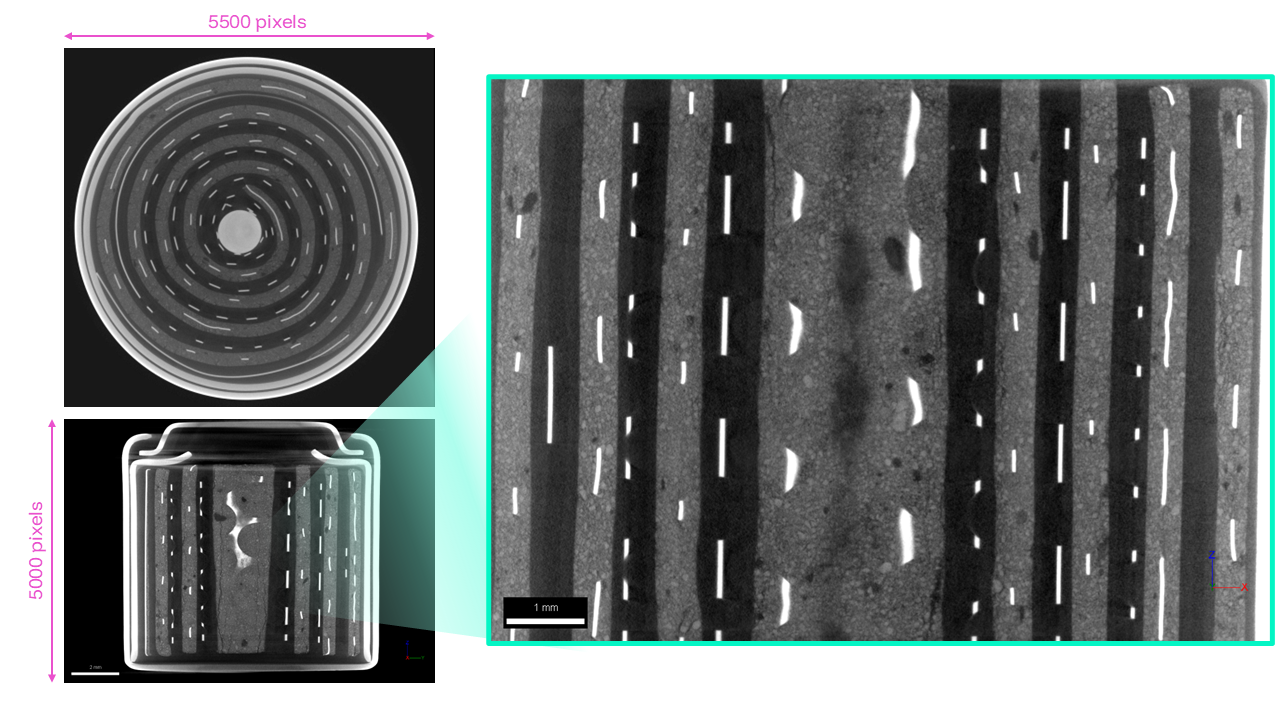

High image quality for diverse life science samples, from insects to contrast-enhanced tissues and biomedical implants
Multi-scale 3D workflows connect whole-specimen context with targeted high-resolution detail using VOIS™
Dynamic micro-CT extends research into food science, biomaterials, and biomechanics studies involving hydration, swelling, deformation, or structural change
Tescan UniTOM® HR enables life science researchers to study diverse biological and biomedical samples in 3D without destructive sectioning. From insects, embryos, and small animal specimens to tissues, bone, teeth, dental materials, and implants, the system delivers high image quality across a broad range of sample types, sizes, and densities. Its multi-scale 3D workflow allows researchers to capture whole-specimen context, then use VOIS™ to focus on selected regions for higher-resolution detail. For food science, biomaterials, and biomechanics research, Tescan UniTOM® HR can also support dynamic micro-CT studies that reveal how internal structures change during processes such as hydration, swelling, or deformation.

Non-destructive 3D characterization of pore networks, fractures, grains, mineral phases, and core-scale heterogeneity
Dynamic micro-CT captures fluid flow, capillary trapping, mineral–fluid interactions, and fracture evolution under controlled experimental conditions
VOIS™ enables targeted high-resolution imaging of critical regions, connecting whole-sample context with pore-scale root-cause analysis
Large scanning envelope that accommodates core plugs and samples up to 40 cm in height
Tescan UniTOM® HR supports geoscience research from high-resolution 3D rock characterization to dynamic fluid-flow and deformation studies. Researchers can first visualize pore networks, fractures, mineral distributions, and structural heterogeneity in 3D, then observe how fluids migrate, become trapped, or alter the sample under controlled conditions. When a critical flow path, fracture, or reaction zone is identified, VOIS™ enables targeted high-resolution imaging of the region of interest without losing the wider geological context. This dynamic-to-detail workflow helps connect pore-scale processes with applications such as CO₂ and H₂ storage, reservoir characterization, mineral dissolution, and geomechanical testing.
.png?width=201&height=200&name=_%20Application%20area%20icon%20(3).png)
Non-destructive spectral imaging for material verification and internal inspection of advanced electronic assemblies.
TrueContrast™ multi-energy imaging for differentiating polymers, metals, and encapsulants
K-edge detection for accurate identification of high-Z elements
Non-destructive visualization of interfaces and buried defects in electronic packages
Spectrum comparison tools for verifying material uniformity and contamination sources
Tescan Spectral CT delivers compositional insight where conventional micro-CT cannot. Engineers can distinguish packaging materials, solder alloys, and internal structures without sectioning or coating—supporting reliable failure analysis, design validation, and quality assurance across next-generation electronic devices.
Multi-energy micro-CT for elemental and structural differentiation in complex, multi-phase materials.
Elemental mapping for identifying fillers, dopants, or additives in polymer composites
Spectral contrast for distinguishing polymers, ceramics, and metals with similar densities
Non-destructive 3D analysis of internal interfaces and phase boundaries
Integrated Spectral Suite for correlating elemental and structural data in one workflow
In materials research, Spectral CT enables scientists to explore the relationship between structure and composition without destroying samples. Researchers can visualize distribution of additives, analyze composite uniformity, and study degradation pathways—supporting more reliable material design and performance assessment.

Full-spectrum micro-CT for 3D elemental and structural insight into geological samples.
Non-destructive 3D elemental mapping of rocks, ores, and mineral inclusions
K-edge detection for locating and identifying high-value or trace elements like gold or rare earth elements
Enhanced contrast for complex mineral assemblages and pore networks
Large-volume spectral scanning for full-core or fragment-scale analysis
For geoscientists and mining professionals, Spectral CT provides simultaneous elemental and structural data from intact samples. It supports mineral identification, ore classification, and recovery assessment—reducing dependency on destructive assays while preserving geological material for further study.
Tescan Spectral CT works seamlessly with SPECTRAL Suite and Acquila™ micro-CT control software to streamline spectral imaging from acquisition to analysis. Used as an add-on with the UniTOM XL platform, users can target volumes of interest, capture full-spectrum data, and visualize structural and elemental information in one workflow.
Researchers benefit from intuitive controls, guided reconstruction, and automated spectral processing. Spectral Suite handles spectrum matching, K-edge detection, and compositional mapping with minimal setup. This delivers consistent, reproducible results across samples and accelerates multi-energy micro-CT analysis.
.png?hsLang=en)