
Micro-CT in clinical environments is becoming an important bridge between research and medicine. In this video interview, Bernadette de Bakker explains why micro-CT became essential to her work, how it advances the study of human development, and why she sees clear potential for its use in hospital workflows. Recorded during the March 2026 opening of a micro-CT system at Amsterdam UMC, the interview brings together embryology, fetal imaging, ultrasound, and a broader view of how high-resolution 3D imaging can support better-informed care. .png?width=588&height=721&name=Bernadette%20de%20Bakker%20%20(1).png) A Career Shaped by Science and Clinical Relevance
A Career Shaped by Science and Clinical Relevance
Bernadette de Bakker, MD, PhD, is an Assistant Professor in Human Embryology and Fetal Imaging at Amsterdam UMC. Her work spans embryology, fetal imaging, pregnancy ultrasound, and non-invasive diagnosis after fetal loss.
In a recent personal reflection, Bernadette looked back over the past 10 years since becoming a physician and the decision that shaped her career. Although she valued direct patient contact during clinical training, she chose to focus on research and education, where she believed she could contribute more broadly. That choice still defines her work today: science grounded in curiosity, with clear clinical relevance.
Why Micro-CT Changed Her Research
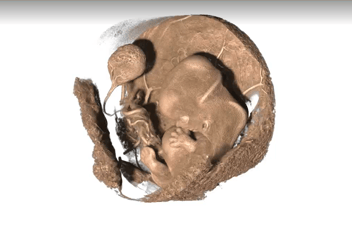
In the interview, Bernadette explains that her early work on embryos relied on microscopy, histological sectioning, and scanning. That approach worked at the embryonic stage, but fetal specimens required a different high-resolution imaging method.
For her, micro-CT provided that next step. It made it possible to study organs in 3D while also revealing smaller structures such as blood vessels and nerves. That matters because embryology is not only about identifying structures. It is about understanding how the body forms in three dimensions, how organs develop in relation to one another, and where that process can diverge in cases of birth defects.
From Embryology to Fetal Imaging
Bernadette also shows how micro-CT can strengthen fetal imaging research. It helps researchers understand embryonic and fetal anatomy in greater detail while providing an anatomical reference for clinical ultrasound.
By comparing micro-CT with ultrasound, researchers can better understand which small organs can already be recognized during prenatal imaging and how those findings should be interpreted. The 3D nature of micro-CT also enables quantitative analysis. Organ volumes can be measured across development, helping researchers track growth and identify stages when specific organs may be more vulnerable, including in relation to maternal medication use.
Why Clinical Environments Matter
Bernadette describes micro-CT inside a hospital as especially powerful because it can add information before conventional sectioning begins. Instead of relying only on individual sections under a microscope, teams could first scan a specimen in 3D and then guide biopsy or sectioning with a fuller anatomical view. In her view, that added context can strengthen analysis and support better-informed care.
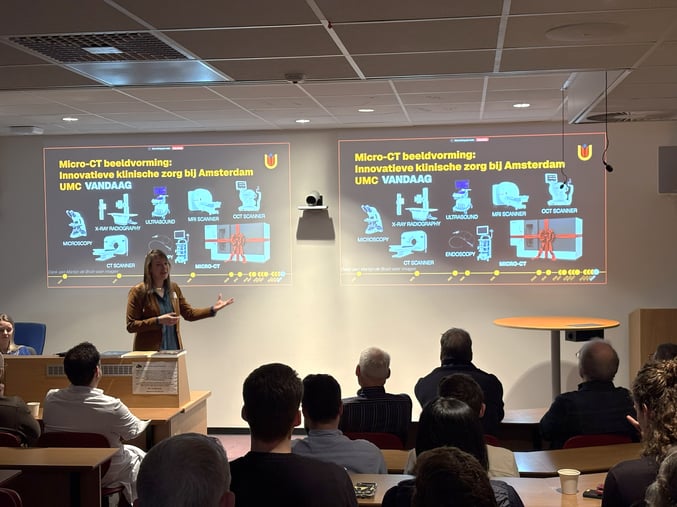
The opening of a micro-CT system in a clinical environment points to a broader shift: high-resolution 3D imaging is moving closer to where clinical and translational questions are asked. Current work already includes research on embryos, fetuses, and organs, with a wider vision that includes biopsy evaluation, assessment of surgical outcomes, and forensic workflows.
Watch the Video Interview
Watch the interview with Bernadette de Bakker to hear how micro-CT became central to her work, how it supports embryology and fetal imaging, and why she believes it can open new possibilities for research and care.


New product releases, application insights, and event updates.
Delivered as a quarterly newsletter with product news, insights, and events.