

On 19–20 February 2026, the INDICO workshop brought European key opinion leaders in focused electron beam induced deposition (FEBID) and focused ion beam induced deposition (FIBID) to Frankfurt, Germany. Hosted at the Frankfurt Innovation Center for Biotechnology (FIZ) and organised by the MBN Research Center, the meeting aligned practical routes toward reliable, computer-guided 3D nanoprinting and clarified what is needed for robust, transferable process control.
Tescan participated as a technology and microscopy provider, supporting the group in evaluating the current state of the art in FEBID and FIBID, and sharing what is possible with today’s tooling and what must come next to reach industrially relevant reliability.
What the INDICO Workshop Set Out to Solve
The COST Innovators Grant (CIG) project IG20129 “INDICO – INnovative DIgital COntrol for 3D Nanoprinting” is focused on developing a digital control tool that will be validated by comparison with dedicated FEBID and FIBID experiments. The goal is to enable 3D nanoprinting of systems relevant for industrial applications, then demonstrate the resulting capabilities and workflows to stakeholders and different target user groups of the INDICO tool.
To achieve this, INDICO connects leading European partners in FEB and FIB-based nanofabrication and materials processing with experts developing and using advanced software tools for multiscale modelling (MM). The project’s intended outcome is to enable the current generation of SEMs to deposit 3D structures with high fidelity and quality, supporting broader use of beam induced deposition as a commercially viable method for constructing nanostructures for industrially relevant applications.
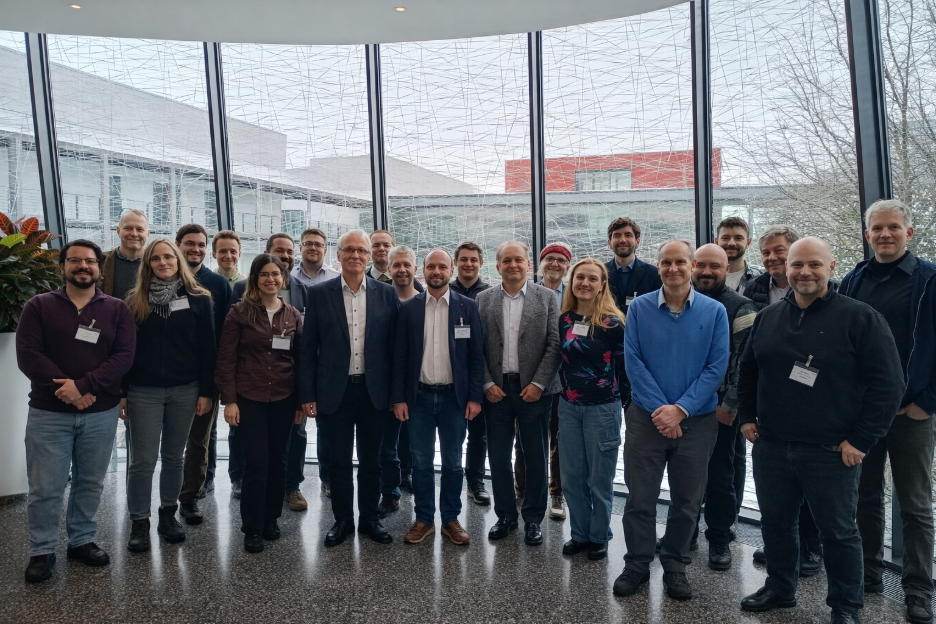 Picture by the MBN Research Center
Workshop Discussion Themes
Discussions focused on three core areas that matter when moving from proof-of-concept structures to repeatable nanoscale 3D printing:
- Using FEBID and FIBID for 3D nanoscale fabrication
Including process windows, practical constraints, and geometry-dependent effects. - Defining the data needed for credible digital control for nanoprinting
Including dose–response behaviour, growth rates, composition and purity indicators, and validation strategies linking experiments to models. - Achieving predictable 3D nanofabrication and sharing workflows across labs
Including how to deposit 3D nanoscale structures with predictable geometry and properties, and how to capture parameters and metadata to enable repeatability and sharing.
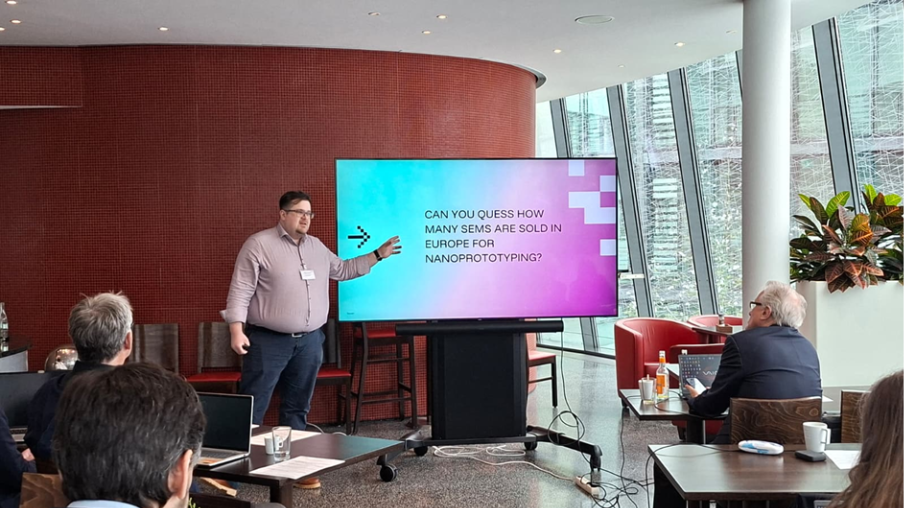
Tescan’s Perspective: What Today’s Tooling Enables, and What Comes Next
Tescan’s outlook covered the technical building blocks required to make SEM-based nanofabrication more predictable and scalable:
- Simulation to improve predictability
- New FEBIP-dedicated systems
- New dedicated FEBIP workflows
- New functional materials and precursors
- Software and hardware retrofits of existing platforms to better support FEBIP
- Active in situ process monitoring with on-the-fly adjustments toward closed-loop control
These topics reflect a shared direction: improving predictability, strengthening in situ process monitoring, and making direct-write nanofabrication workflows easier to validate and transfer.
Written by Miloš Hrabovský
Product Marketing Manager, Tescan


New product releases, application insights, and event updates.
Delivered as a quarterly newsletter with product news, insights, and events.