
WEBINAR | Correlated Microanalytical Workflows for Particle Analysis Using Automated Mineralogy, FIB-SEM and SIMS

Back to the webinars

WEBINAR | Correlated Microanalytical Workflows for Particle Analysis Using Automated Mineralogy, FIB-SEM and SIMS 

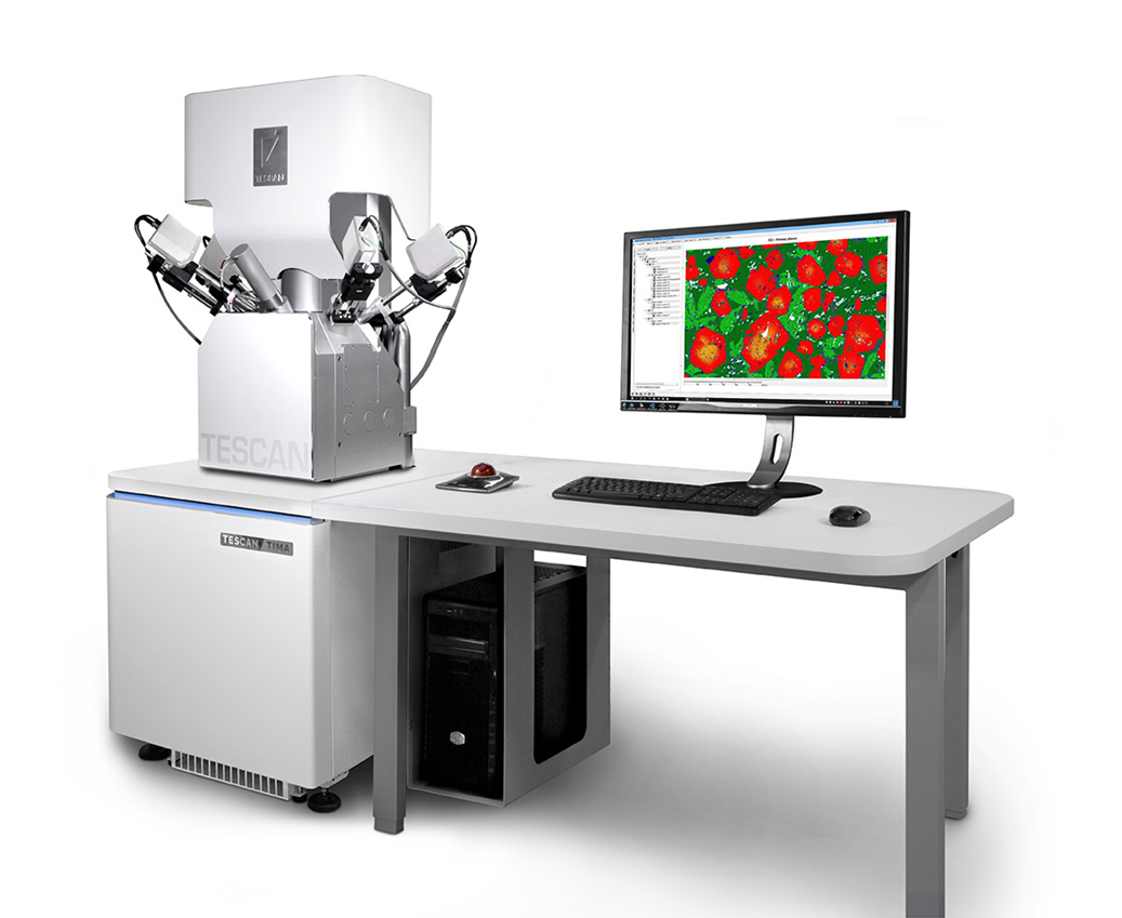
 Micrometer-sized particles can reveal critical information in environmental, geological, and nuclear sciences. To fully characterize them, researchers often need more than one analytical method. This webinar explores how correlated workflows combine morphology, phase, chemistry, and isotopic data to build a more complete picture. 

May 27, 2026

Morning session: 9:00 AM CET

Afternoon session: 5:00 PM CET

Professor William Rickard will present workflows that integrate Automated Mineralogy, FIB-SEM, ToF-SIMS, and LG-SIMS for the sequential analysis of a single particle or region of interest. Using a patterned silicon substrate and an affine coordinate transformation, his team enables precise particle relocation across electron microscopy and mass spectrometry instruments.

This approach supports high-throughput, large-area particle search followed by targeted, multi-instrument characterization. It helps researchers investigate complex scientific questions with greater accuracy and efficiency.


Why This Matters

Correlated workflows are increasingly important in particle analysis because no single technique can provide all the necessary information. By combining large-area particle search with targeted multi-instrument characterization, researchers can gain a more complete understanding of particle properties and generate more reliable datasets.


What You Will Learn

  • How correlated workflows support more complete particle characterization

  • How the same particle can be relocated across multiple instruments

  • How Automated Mineralogy, FIB-SEM, ToF-SIMS, and LG-SIMS complement one another

  • How high-throughput particle search can be linked to targeted characterization


Who Should Join

  • Geoscientists working with complex particle characterization

  • Researchers in environmental and nuclear sciences analyzing micrometer-sized particles

  • Experts in microanalysis techniques such as LA-ICP-MS, EPMA and SIMS

  • Electron microscopy and FIB-SEM users interested in correlative workflows

  • Scientists seeking more precise localization and cross-instrument analysis of regions of interest


Register for the webinar
to learn how correlated microanalytical workflows can support more precise and efficient particle analysis across multiple instruments.

Speakers

William Rickard-1
Professor William Rickard

Director of the John de Laeter Centre, Curtin University

Prof. Rickard is a Materials Scientist and the Director of the John de Laeter Centre (JdLC) at Curtin University.

He is an experienced researcher (>150 peer-reviewed publications) with interests in micro- to nano-scale chemistry and the structure of minerals and materials.

He has almost 20 years of experience working in university analytical facilities and specializes in imaging mass spectrometry (ToF-SIMS), focused ion beam – scanning electron microscopy (FIB-SEM), and associated microanalytical techniques (EDS, EBSD, SIMS).

He has been at the forefront of the development of FIB-SIMS applications as well as techniques for correlative analyses involving electron microscopy, mass spectrometry, and atom probe tomography. 
Eligiusz Przemyslaw Gugala, Tescan
Eligiusz Przemyslaw Gugala

Product Manager, Tescan


Eligiusz transitioned from a career in mineralogy into product management, bringing strong hands‑on experience with automated mineralogy in real industrial environments.

Through his work optimizing plant recovery, he gained first‑hand insight into the challenges of high‑volume materials characterization.

At Tescan, Eligiusz now applies this operational knowledge to shaping the R&D roadmap for TIMA and SEM solutions.

His focus is on aligning advanced hardware technologies, including detectors and optics, with intelligent software automation to deliver reliable, high‑performance instruments for applications in Mining, Batteries, and Materials Science.

Webinar registration


Register for the webinar