How Nanoscale Geometry Rewrites Cell Behavior
The behavior of cells is shaped by a complex interplay of biochemical signals and physical cues within the microenvironment. The interactions between cells, extracellular matrix proteins, and soluble factors occur at scales that are often too small to replicate using conventional in vitro methods. So, what if we could finally mimic the microenvironment at the nanoscale?
This application note introduces an innovative workflow based on electron beam lithography (EBL) that has been optimized for use in biological applications. This method enables the generation of large-area, high-resolution nanopatterns on substrates compatible with cell culture. Combining conductive indium tin oxide coatings, protein-repellent PEG layers, and covalent biomolecule immobilization via HaloTag chemistry allows researchers to control the precise spatial distribution of functional proteins at the nanometer scale.
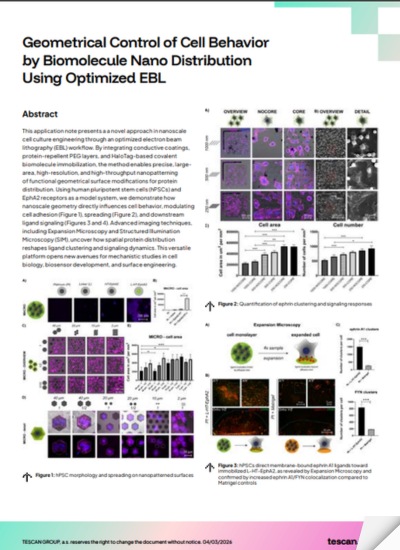
To demonstrate the biological relevance of this approach, we used human pluripotent stem cells (hPSCs) and EphA2 receptors as a model system. EphA2 is a membrane-bound receptor involved in cell–cell communication, and its activation depends on nanoscale clustering with ephrin ligands. By immobilizing EphA2 in defined hexagonal nanopatterns, we were able to study how geometry influences:
-
Cell adhesion and spreading: hPSCs adapted their morphology and cytoskeletal organisation in response to nanopatterned surfaces, their spreading behaviour depending on the density and geometry of the pattern.
-
Ligand clustering and intracellular signaling: Using Expansion Microscopy and Structured Illumination Microscopy (SIM), we visualized ephrin A1 and A3 ligand clusters forming in response to EphA2 nanodistribution. The size, number, and spatial organization of these clusters depended on the pattern spacing.
-
Temporal dynamics of ligand behavior: Time-course imaging revealed that Ephrin clustering is a dynamic process that peaks around 60 minutes after cell seeding. The density of nanopatterns influences both the number of clusters and their activation, as demonstrated by colocalisation with FYN kinase.
These findings further highlight the significance of nanoscale geometry in modulating cellular responses. Even subtle changes in the spatial arrangement of proteins can dramatically alter how cells adhere, communicate, and signal.
Why It Matters
This biologically adapted EBL workflow opens up new possibilities for in-depth studies in cell biology, particularly regarding how spatial cues influence receptor-ligand interactions. It also shows promise in biosensor development, tissue engineering, and designing bioactive surfaces.
The platform is reproducible and scalable. It is also compatible with a wide range of biomolecules and cell types. Whether you are investigating stem cell differentiation, receptor signaling, or designing next-generation biomaterials, this approach provides a powerful tool for achieving nanoscale control.
Curious to see how geometry influences biology?
Download the full application note and explore the science behind nanoscale patterning and cellular behavior.