Micro-CT imaging has become an essential tool for natural history museums, zoological research, and large-scale specimen digitization projects. However, imaging large biological specimens at high resolution has traditionally been limited by sample size constraints. While clinical CT systems can accommodate larger samples, they often lack the resolution required to study fine anatomical structures. This challenge becomes particularly significant when examining rare and valuable specimens such as fetal baleen whales, where non-destructive analysis is critical.
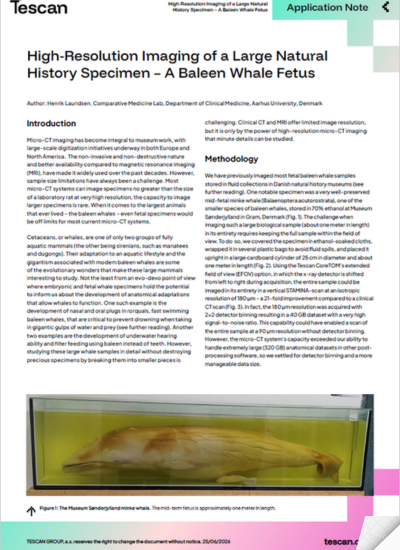
Discover how Tescan CoreTOM enables high-resolution micro-CT imaging of large natural history specimens, including a one-meter-long baleen whale fetus. Using extended field-of-view scanning, researchers can capture detailed three-dimensional datasets of entire specimens while preserving delicate anatomical features. This approach provides unprecedented insight into developmental biology, comparative anatomy, evolutionary research, and museum digitization, revealing structures such as the developing inner ear and transient tooth buds with significantly greater detail than conventional clinical CT imaging.