.png?width=107&height=26&name=Tescan(Logo).png "Tescan(Logo)")
In gold mining and ore processing, recovery is a critical economic factor. However, it often varies significantly across a deposit. Processing performance is governed by mineralogical factors, including gold grain size distribution, the association of gold with host minerals, the presence of sulphide-hosted refractory gold, and gangue minerals that influence leaching kinetics or cyanide consumption. This variability is difficult to predict using conventional geological logging or bulk assays alone, because these methods often cannot resolve fine-grained, locked, or refractory gold and link it reliably to specific geological domains.
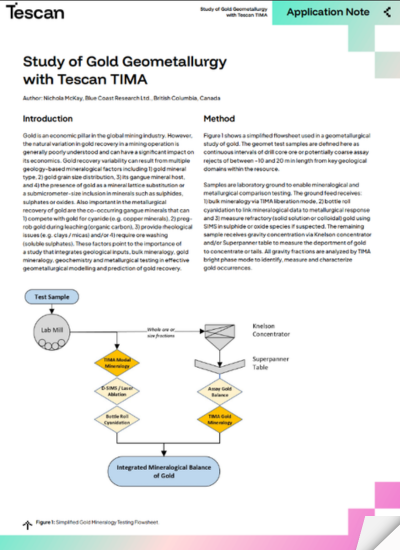
Discover how Tescan TIMA™ addresses this challenge by combining automated mineralogy analysis with high-resolution imaging to asses gold grain size, mineral associations, and locking, providing reliable data for geometallurgical modelling and gold recovery prediction.