
WEBINAR | Up to 40% Faster Automated TEM Lamella Preparation with new Ga⁺ FIB Column

Real-Time Phase Evolution in Additively Manufactured Steel

Automated in situ EBSD reveals transient transformations during high-temperature treatment.

hero
hero
Unlocked content

Watch, Don’t Guess. Track Microstructure in Real Time

Heat treatments shape the final properties of metal components, especially in additively manufactured steels. But most of what we know comes from before-and-after snapshots. That leaves a gap: What exactly happens in between? How do new grains form, and what drives them?

To answer these questions, researchers utilized in situ heating, automated EBSD acquisition, and ultra-high-resolution SEM imaging, all on a single Tescan SEM. The result was a time-lapse of crystallographic evolution during heat treatment, offering a look into transformations that would otherwise remain hidden.

Why In Situ EBSD

Changes the Game?

01
Root of the Problem

Static Tools Miss Dynamic Changes

Traditional EBSD methods are excellent for documenting structure. But only before and after thermal treatment: During heating, critical transitions unfold that can’t be captured once the system cools. In the case of martensitic steels, this means missing intermediate phases and mechanisms that control recrystallization and final grain size.

To truly understand heat-driven transformations, especially in complex materials like additively manufactured steels, researchers need a way to track microstructural change as it happens, not just infer what probably occurred.

02
Materials and Methods

Automated In Situ EBSD During Controlled Heating

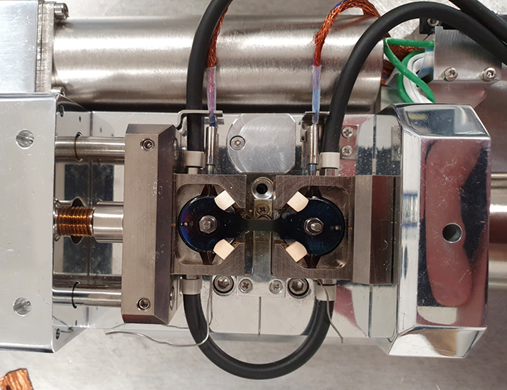
The sample was a wire-arc additively manufactured 300M martensitic–bainitic low-alloy steel. Heating was carried out using a NewTec FurnaSEM stage, fully integrated with a Tescan CLARA UHR SEM.

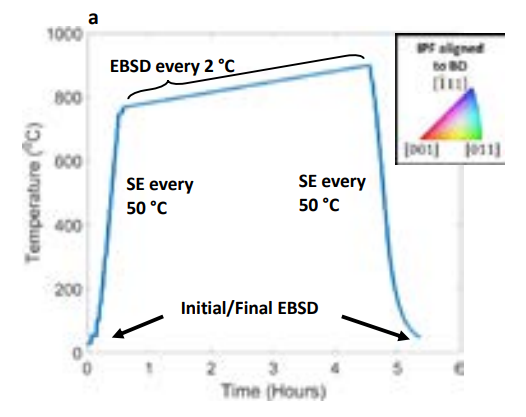
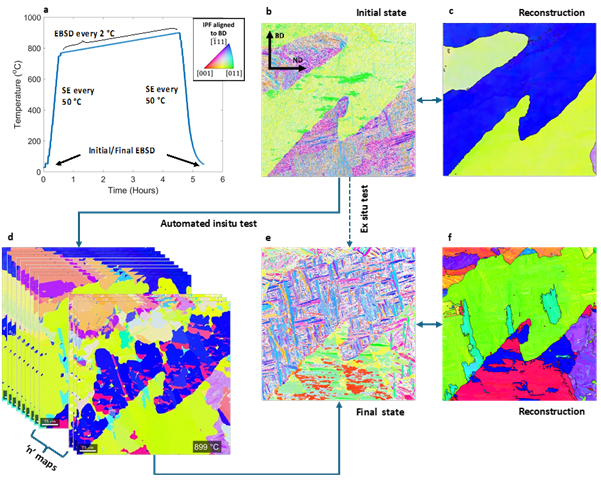
Data collection followed a structured sequence: EBSD maps were acquired every 2 °C between 750 °C and 900 °C, with secondary electron images captured every 50 °C. Pre- and post-heating EBSD maps provided baseline and endpoint comparisons.

The sample was mounted in the furnace stage inside the SEM, with roughened zirconium coupons placed nearby to capture any free oxygen released during heating and protect the chamber.

All stage control, imaging, and data logging were automated via eRemora (NewTec), controlling the SEM, heating stage, and EBSD through SharkSEM and Oxford Instruments Aztec APIs, with no user intervention.

03
Results and Discussion

Transient Phases, Caught in the Act

Throughout the heating cycle, EBSD revealed a phase that had never been observed directly: a misoriented intermediate structure between lath martensite and fully recrystallized austenite. Caused by a memory effect, this phase displayed high kernel average misorientation (KAM), suggesting localized stress and recrystallization potential.

As the temperature increased, these high-KAM zones acted as nucleation points. The low-KAM grains that emerged gradually replaced them, leading to a fully recrystallized microstructure by 900 °C. None of this was visible in pre- or post-heating EBSD alone.

The experiment showed that dynamic grain evolution can now be studied in real time, giving metallurgists a powerful tool for understanding how temperature, structure, and time interact in AM steels and beyond.

GET IN Touch

Contact us

Get the most out of Tescan

This is more than information; it's an advantage. We've compiled our technical whitepapers, detailed product flyers, and on-demand webinars to provide you with the knowledge that makes a real difference. Sign up now to access the insights you need to make an impact.

Tescan Instruments & Technology

Used in This Workflow

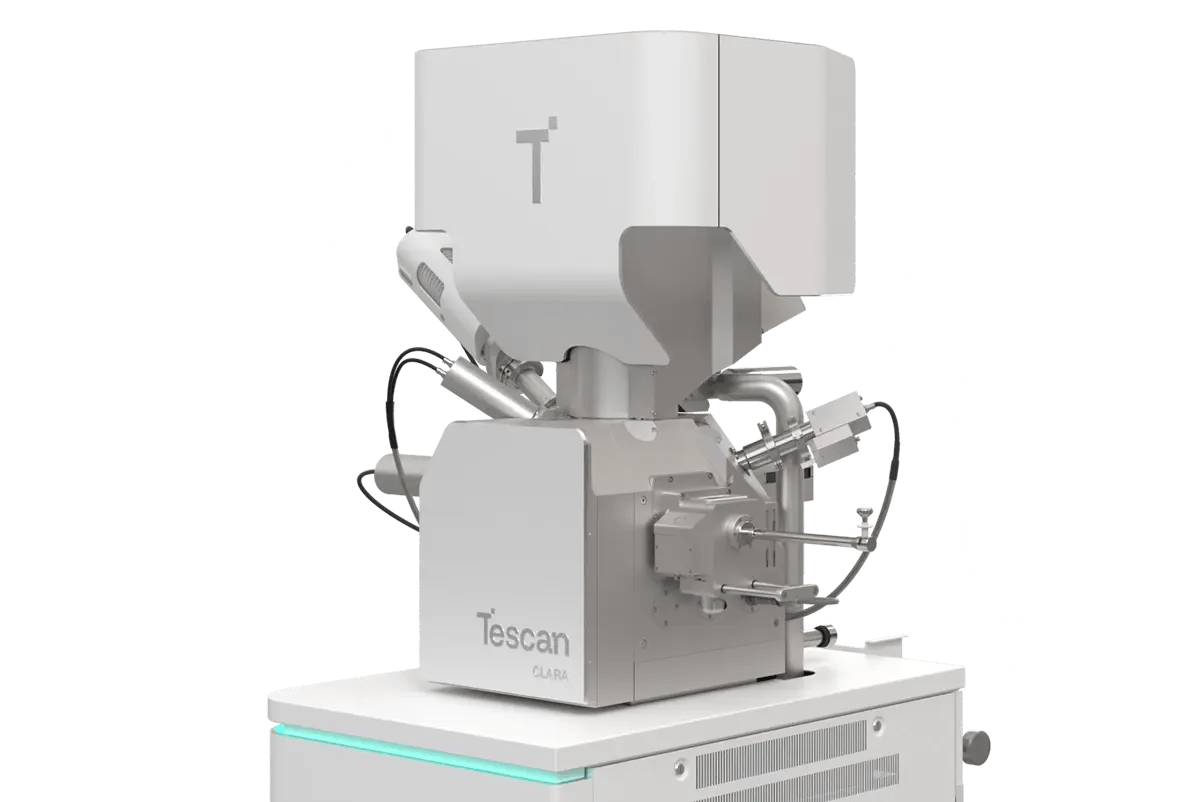
Tescan CLARA

Combines sub-nanometer resolution with advanced analytics and automation

  • Full integration of in situ heating setup, including imaging and EBSD

  • Automation for days-long, unattended image and EBSD map acquisitions

  • High-quality imaging over long periods, thanks to drift compensation and automatic refocusing
CLARA GM Mat. Science

SEM ExpertPI – Imaging Automation and Control API

Open API that allows full control of imaging parameters, automation, and multi-modal workflows.

  • Integrated with stage and EBSD software for real-time synchronization

  • Enables unattended, reproducible in situ acquisition sequences

GET IN Touch

Contact us

map

Where can you find us:

Tescan Brno
Libušina třída 21
623 00 Brno
Czech Republic

info@Tescan.com