
1. Introduction
Modern materials are no longer uniform solids. Energy storage systems, additive-manufactured parts, electronic packages, and geological materials are all heterogeneous, hierarchical, and multiscale by design. Their performance is governed not by a single feature, but by interactions between structures spanning millimeters down to nanometers, often coupled with local chemistry.
Lithium-ion batteries are a clear example. A single cell combines dense metal current collectors, brittle oxide particles, soft polymer binders, porous separators, and chemically active interfaces. Degradation mechanisms-cracking, particle delamination, binder aging, interphase growth-occur across multiple length scales and evolve during operation. No single characterization technique can capture this complexity.
This drives the need for correlative, multiscale workflows that connect non-destructive 3D imaging with high-resolution structural and chemical analysis. A practical and increasingly adopted solution is the integration of X-ray micro-computed tomography (micro-CT) with plasma FIB-SEM–based 3D analytics.
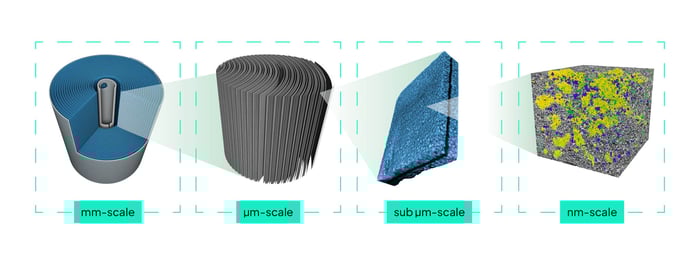
Figure 1: Correlative multiscale workflow from non-destructive micro-CT to analytical plasma FIB-SEM. The sequence progresses from whole-cell imaging (mm scale), through electrode stack architecture (µm scale), to single-foil resolution, and finally to nanoscale 3D FIB-SEM analysis of local microstructural and chemical features.
2. Tescan Solutions
Tescan's materials characterization platforms are designed around one core requirement: link statistically relevant volumes to nanoscale mechanisms without compromising sample throughput.
2.1 Role of Micro-CT
Micro-CT provides the non-destructive, volumetric foundation of the workflow. By reconstructing 3D volumes from X-ray attenuation, it allows researchers to visualize internal structures without sectioning or altering the sample.
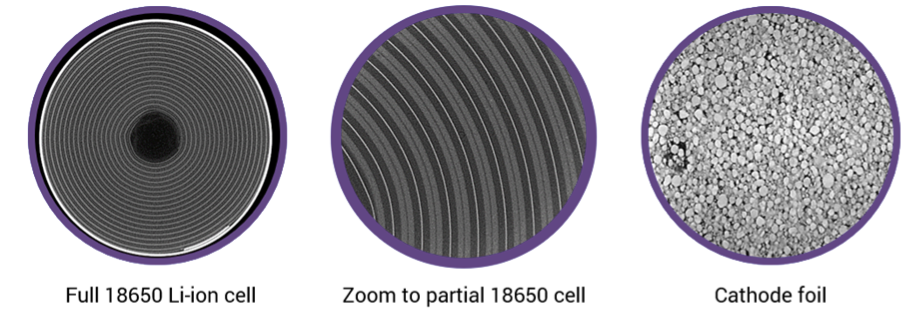
Figure 2: Volume-of-interest feature on Tescan micro-CT enabling seamless transition from sample-scale overview to high-resolution imaging of individual particles.
For heterogeneous materials, micro-CT is used to:
- Quantify porosity, cracks, and void networks
- Detect buried defects and manufacturing non-uniformities
- Track structural evolution during cycling or loading (4D imaging)
- Maintain statistical relevance by imaging large volumes
Tescan micro-CT systems support volume-of-interest scanning (VOIS), enabling high-resolution imaging of local regions while preserving global context. This is critical when failure initiates locally but is driven by global constraints, such as electrode stack pressure or component geometry.
High-throughput architectures, such as large-capacity or dynamic CT systems, further enable time-resolved studies under mechanical, thermal, or chemical changes. This shifts micro-CT from a purely descriptive tool to a quantitative, in-situ method for materials research.
2.2 Role of Plasma FIB-SEM
Micro-CT identifies where critical features exist. Plasma FIB-SEM reveals why they form.
Focused ion beam–scanning electron microscopy enables site-specific cross-sectioning and 3D tomography at sub-micron to nanometer resolution. However, conventional gallium FIB systems are poorly suited for large, heterogeneous volumes due to low milling rates and ion-induced artifacts.
Plasma FIB-SEM overcomes these limits by using a high-current xenon ion source:
- Milling rates up to ~50× faster than Ga⁺ FIB
- Cross-sections approaching millimeter dimensions
- No gallium implantation or alloying effects
- Improved suitability for polymers, composites, and battery materials
This makes plasma FIB-SEM essential for capturing representative elementary volumes in real materials, rather than isolated nanoscale features with limited statistical meaning.
Tescan advanced milling strategies further suppress curtaining artifacts, producing flat, damage-minimized surfaces suitable for high-quality analytical mapping.
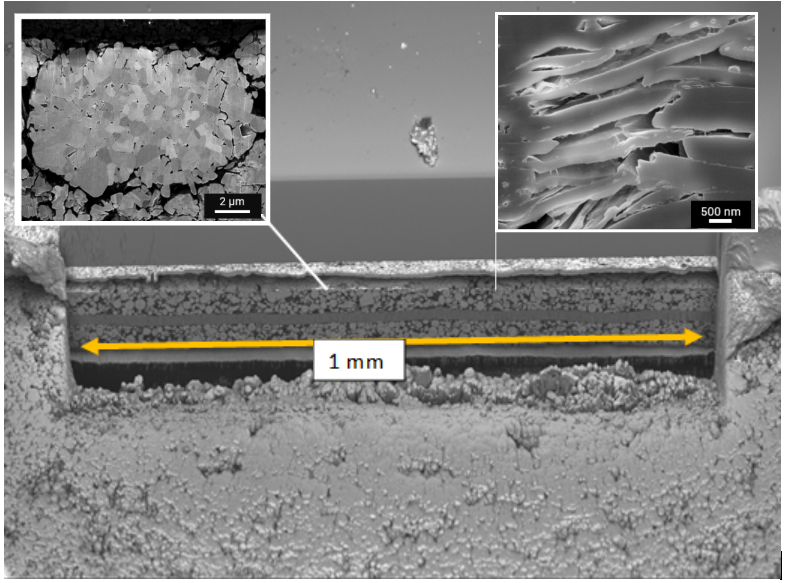
Figure 3: Large-area (~1 mm) cross-section prepared by xenon plasma FIB, revealing particle-scale cracking across the full electrode thickness. High-magnification SEM imaging resolves nanoscale fracture features within individual secondary particles, linking macroscopic damage to sub-particle failure mechanisms.
2.3 3D Tomography and 3D Tomography with ToF-SIMS
The full value of plasma FIB-SEM emerges when combined with multimodal 3D analytics.
Sequential FIB slicing and SEM imaging enable true 3D reconstruction of microstructures such as particle networks, cracks, and interphases. When coupled with analytical detectors, this structural data can be directly correlated with chemistry and crystallography.
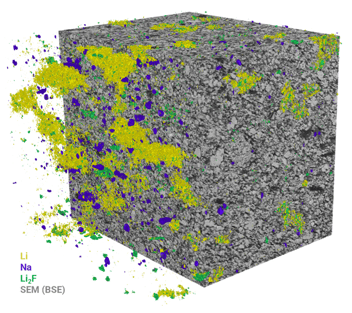
Figure 4: Three-dimensional ToF-SIMS chemical mapping of a cycled LiFePO₄ (LFP) cathode, revealing the spatial distribution and connectivity of lithium, sodium, and Li₂F. Correlation of chemical signals with the 3D microstructure enables direct analysis of ion transport pathways and their relationship to cathode porosity.
Key modalities include:
- Heterogeneous materials demand multiscale workflows, not single instruments
- Micro-CT provides non-destructive, statistically relevant 3D context
- Plasma FIB-SEM bridges the gap to nanoscale mechanisms with high throughput and minimal artifacts
- Correlative 3D analytics (EDS, Raman, ToF-SIMS) link structure, chemistry, and performance
- Battery materials exemplify the challenge, but the workflow generalizes to additive manufacturing, semiconductors, geoscience, and composites
3D ToF-SIMS tomography is particularly powerful in battery research, where it enables visualization of lithium transport, interphase formation, and chemical gradients with nanometer resolution and ppm sensitivity-capabilities inaccessible to EDS or X-ray methods alone.
3. Key Takeaways
- EDS for elemental phase distribution
- EBSD for grain orientation and phase identification
- Raman-SEM (RISE) for molecular and polymer characterization
- ToF-SIMS for trace elements and light species (e.g., lithium)
By integrating micro-CT with plasma FIB-SEM–based 3D tomography, materials scientists can move beyond isolated observations toward mechanistic understanding across length scales-from component-level behavior down to chemical processes at buried interfaces.
Written by Petr Klimek, PhD


New product releases, application insights, and event updates.
Delivered as a quarterly newsletter with product news, insights, and events.