.png?width=107&height=26&name=Tescan(Logo).png "Tescan(Logo)")
Sub-micron detail inside bulky in-situ hardware
When the sample is surrounded by hardware, removing it to gain resolution breaks the experimental chain. UniTOM® HR 2’s high-resolution detector options enable sub-micron imaging even inside bulky in-situ setups, including Deben tensile or compression stages. When maximum spatial resolution is the priority, the High-Resolution sCMOS option offers the smallest pixel size in the detector portfolio.
Resolution without restriction
High-Resolution sCMOS X-ray Detector
Sub-micron resolution at large working distances for low-attenuation and in-situ samples.
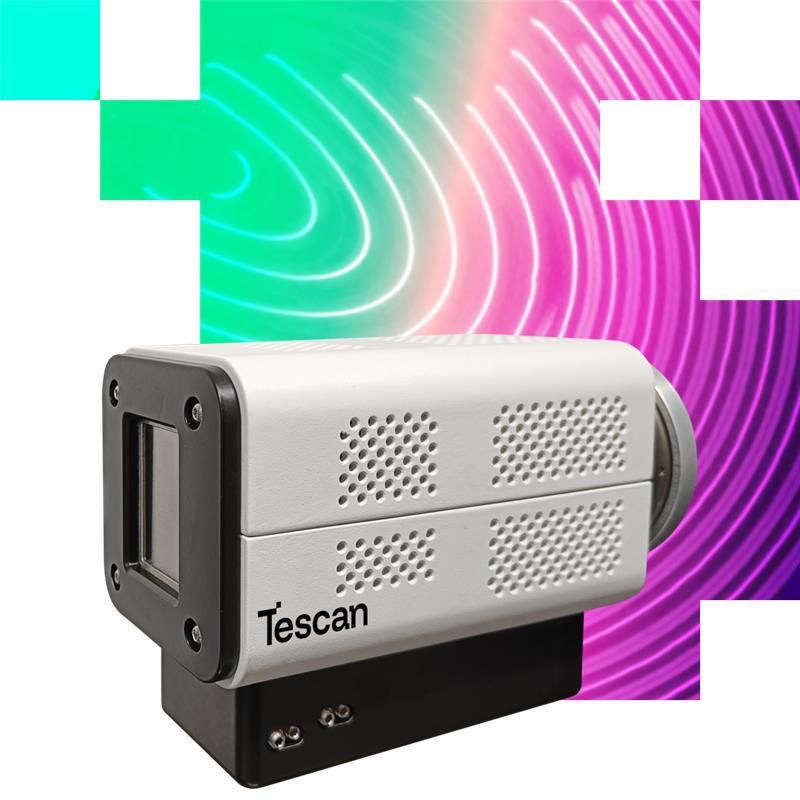

Many experiments cannot move the sample close to the X-ray source. Bulky in-situ stages, environmental chambers, and large specimens create a fixed working distance, where geometric magnification fails to deliver the detail you need. The High-Resolution sCMOS detector option for UniTOM® HR 2 is designed to maintain high resolution, even at large working distances. A highly sensitive small-pixel scientific CMOS sensor supports sub-micron imaging on samples up to 10x larger.
This matters most when you cannot cut the sample to “make it fit.” Cutting for resolution can destroy context and invalidate conclusions, especially in multi-step or time-dependent studies. In in-situ experiments, the High-Resolution sCMOS detector supports sub-micron imaging within the experimental setup, so you can protect experimental continuity and keep evidence connected to the real conditions.
Low-attenuation contrast is another common barrier in advanced X-ray CT workflows. Soft tissue, polymers, and carbon fiber composites can look washed out on standard flat panels. The sCMOS sensor improves contrast and reduces noise for low-Z materials, helping you distinguish subtle boundaries and features that may be hard to separate on standard flat panels.
The High-Resolution sCMOS detector is built to fit automated, multi-scale workflows. When integrated with Volume and detector switching, it becomes the high-resolution “detail” step that follows an overview scan or a fast dynamic sequence, without removing the sample or losing context. VOIS lets you select a region from an overview volume and automatically reposition for a targeted, higher-resolution follow-up scan.
In one glance
-
Sub-micron imaging in real in-situ setups: up to 5x smaller voxel size with a sample inside a Deben tensile or compression stage.
- High resolution on larger low-density samples: 1 µm voxel size for low-density samples up to 10x larger, including biological specimens, carbon fibers, and polymers.
- Clearer low-attenuation contrast: high-sensitivity sCMOS supports exceptional contrast and low-noise imaging for soft tissues and low-Z materials.
- Low-dose, high-contrast imaging: helps reduce exposure time and dose for dose-sensitive biological samples and low-contrast polymers while preserving usable detail.
- ROI-ready workflows: support automated multi-scale imaging with VOIS and detector switching.
.png?width=201&height=200&name=_%20Application%20area%20icon%20(3).png)
Tescan Spectral CT in Electronics and Semiconductors
Non-destructive spectral imaging for material verification and internal inspection of advanced electronic assemblies.
TrueContrast™ multi-energy imaging for differentiating polymers, metals, and encapsulants
-
K-edge detection for accurate identification of high-Z elements
-
Non-destructive visualization of interfaces and buried defects in electronic packages
-
Spectrum comparison tools for verifying material uniformity and contamination sources
Tescan Spectral CT delivers compositional insight where conventional micro-CT cannot. Engineers can distinguish packaging materials, solder alloys, and internal structures without sectioning or coating—supporting reliable failure analysis, design validation, and quality assurance across next-generation electronic devices.

Tescan Spectral CT in Materials Science
Multi-energy micro-CT for elemental and structural differentiation in complex, multi-phase materials.
-
Elemental mapping for identifying fillers, dopants, or additives in polymer composites
-
Spectral contrast for distinguishing polymers, ceramics, and metals with similar densities
-
Non-destructive 3D analysis of internal interfaces and phase boundaries
-
Integrated Spectral Suite for correlating elemental and structural data in one workflow
In materials research, Spectral CT enables scientists to explore the relationship between structure and composition without destroying samples. Researchers can visualize distribution of additives, analyze composite uniformity, and study degradation pathways—supporting more reliable material design and performance assessment.

Tescan Spectral CT in Geoscience and Mining
Full-spectrum micro-CT for 3D elemental and structural insight into geological samples.
-
Non-destructive 3D elemental mapping of rocks, ores, and mineral inclusions
-
K-edge detection for locating and identifying high-value or trace elements like gold or rare earth elements
-
Enhanced contrast for complex mineral assemblages and pore networks
-
Large-volume spectral scanning for full-core or fragment-scale analysis
For geoscientists and mining professionals, Spectral CT provides simultaneous elemental and structural data from intact samples. It supports mineral identification, ore classification, and recovery assessment—reducing dependency on destructive assays while preserving geological material for further study.
INTEGRATION THAT DRIVES INSIGHT
Tescan Spectral CT works seamlessly with SPECTRAL Suite and Acquila™ micro-CT control software to streamline spectral imaging from acquisition to analysis. Used as an add-on with the UniTOM XL platform, users can target volumes of interest, capture full-spectrum data, and visualize structural and elemental information in one workflow.
Researchers benefit from intuitive controls, guided reconstruction, and automated spectral processing. Spectral Suite handles spectrum matching, K-edge detection, and compositional mapping with minimal setup. This delivers consistent, reproducible results across samples and accelerates multi-energy micro-CT analysis.
.png?hsLang=en)
Technical specification
.jpg?width=350&height=350&name=Untitled%20design%20(4).jpg)
Contact us